
West Fraser Purchases Norbord For $3 Billion

West Fraser Purchases Norbord For $3 Billion

West Fraser Timber Co. Ltd. is acquiring all of the outstanding common shares of Norbord, the world’s largest oriented strandboard producer, for $3.1 billion. Following closing, the combined company will operate as West Fraser.

“Norbord’s OSB production is a perfect complement to the West Fraser portfolio, enabling us to deliver a wider range of wood products, and making us a more complete, efficient and valuable partner for our customers,” says Raymond Ferris, President and CEO of West Fraser.

Norbord operates 17 plant locations in the U.S., Europe and Canada, encompassing 15 OSB mills, one MDF plant, two particleboard facilities and a furniture plant.

West Fraser operates 34 sawmills in British Columbia, Alberta and the Southern U.S., as well as three plywood operations and two MDF facilities in Western Canada.

West Fraser will continue to be led by Ferris as CEO and Chris Virostek as CFO. Peter Wijnbergen, President and CEO of Norbord, will be appointed President, Engineered Wood, responsible for the company’s OSB, plywood, particleboard, MDF and veneer operations. Sean McLaren, currently West Fraser’s Vice-President, U.S. Lumber, will be appointed President, Solid Wood, responsible for all of the company’s lumber operations.

RELATED ARTICLES

CHAMBORD IS THE COMEBACK KID


Latest News

Vecoplan AG Announces New CEO

Vecoplan AG Announces New CEO Following Eric Jaschke's appointment to Chief Financial Officer (CFO) in December 2025, Vecoplan AG has also...

Find Us On Social

Newsletter

The monthly Panel World Industry Newsletter reaches over 3,000 who represent primary panel production operations.

Subscribe/Renew

Panel World is delivered six times per year to North American and international professionals, who represent primary panel production operations. Subscriptions are FREE to qualified individuals.

Advertise

Complete the online form so we can direct you to the appropriate Sales Representative. Contact us today!


500 Has A Nice Ring To It

500 Has A Nice Ring To It

500 Has A Nice Ring To It

500 HAS A NICE RING TO ITArticle by Rich Donnell, Editor-in-Chief, Panel World January 2020

In baseball, 500 is a magical number, and if a player hits 500 home runs during his career he’s on track to make the Hall of Fame. This issue of Panel World is number 500 in its 60-year lifespan, having been founded in 1960; and while Panel World may not be destined for anybody’s Hall of Fame, there’s still something to be said for its longevity as we enter 2020.

The fact that this is the 500th issue had slipped by us editors. Nobody on the editorial staff had thought about it, and we were in the process of planning the editorial content for this issue, when Shelley Smith in our production department buzzed me and asked me if were going to do anything special, given that this is the 500th issue of Panel World.

Actually we had done something special back in our March 2010 issue, when we devoted much of the issue to the 50-year anniversary of Panel World. So after giving it some thought I felt there would have been too much redundancy in doing something similar with this issue. But certainly number 500 deserves a mention. So thank you, Shelley.

James Burrell was the founder and the first editor of Panel World’s predecessor. He had been an editor for two other wood industry publications based in Indianapolis that had just been sold. He tells the story of sitting down at his desk in March 1960 and trying to decide what kind of magazine he wanted to start, blessed with financial support from Review Publishing Co., which later merged with Curtis Publishing Co. Burrell settled on the veneer and plywood industries. He simply called the magazine, Plywood. In 1966 he changed the name to Plywood & Panel with the intent of adding coverage of the particleboard and hardboard sectors.

Hatton-Brown Publishers of Montgomery, Ala., which already published three magazines in the forest products field, purchased the magazine in 1982, formed a separate company to oversee it and changed the name to Plywood & Panel World. I joined Hatton-Brown late in 1983 and in addition to my editorial duties on the other publications, I was told to join the editorial effort to make the magazine something better.

Right away we went hard after mill project and startup stories, while still covering industry news and product technologies. We also wrote about the personalities behind some of the great companies involved in the panel industry. That’s a formula that hasn’t changed much since then. Industry led us to where we needed to go with our coverage, which soon went beyond veneer and plywood and into particleboard, MDF, OSB and engineered wood products. In 1990, we changed the name to Panel World.

It’s been a great ride, and many great editors have traveled many miles to get Panel World to where it is today. And there’s still plenty left in the tank.


Latest News

Vecoplan AG Announces New CEO

Vecoplan AG Announces New CEO Following Eric Jaschke's appointment to Chief Financial Officer (CFO) in December 2025, Vecoplan AG has also...

Find Us On Social

Newsletter

The monthly Panel World Industry Newsletter reaches over 3,000 who represent primary panel production operations.

Subscribe/Renew

Panel World is delivered six times per year to North American and international professionals, who represent primary panel production operations. Subscriptions are FREE to qualified individuals.

Advertise

Complete the online form so we can direct you to the appropriate Sales Representative. Contact us today!
U.S. Court Says China At Fault

U.S. Court Says China At Fault

U.S. Court Says China At Fault


U.S. Court of International Trade in June upheld a U.S. International Trade Commission determination that the People’s Republic of China is injuring the U.S. hardwood plywood industry by exporting hardwood plywood supported by unfair subsidies and selling it at below market value (otherwise known as dumping) in the U.S.

The decision stems from a petition filed by the Coalition for Fair Trade of Hardwood Plywood with the U.S. Dept. of Commerce and ITC in November 2016. In its preliminary determination, Commerce found that hardwood plywood from the PRC was being sold at less than fair value and that the PRC industry was receiving countervailable subsidies.

Concurrent with Commerce’s proceedings, the ITC investigated whether the domestic industry was materially injured or threatened with material injury by the imports. ITC issued a preliminary determination find that there was reasonable indication of injury to the U.S. industry, and subsequently in a final determination concluded that the U.S. hardwood plywood industry is materially injured by the PRC imports because they’re subsidized and sold in the U.S. at less than fair value.

The Coalition for Fair Trade of Hardwood Plywood includes Columbia Forest Products, Commonwealth Plywood, Murphy Company, Roseburg Forest Products, States Industries and Timber Products Co., all domestic producers of hardwood plywood.

American Alliance for Hardwood Plywood and related companies subsequently challenged aspects of the ITC final determination of injury. These companies include Far East American, Inc., Northwest Hardwoods, American Pacific Plywood, Canusa Wood Products, Concannon Lumber and Plywood, Fabuwood Cabinetry Corp., Hardwoods Specialty Products, Holland Southwest International, Liberty Wood International, McCorry & Co., MJB Wood Group, Patrioit Tmber Products, Richmond International Forest Products, Taraca Pacific, USPly Trade Co. and Wood Brokerage International. A separate complaint against the ITC ruling was filed by Zhejiang Dehua TB Import & Export Co. and affiliated plaintiffs.

The complaints against the ITC injury determination challenged the ITC’s findings that imports from PRC are substitutable with domestic hardwood plywood; that the volume of imports from PRC are significant; that imports from PRC undersold domestic hardwood plywood and resulted in price suppression; that imports from PRC significantly impacted the domestic industry.

U.S. Court of International Trade denounced these challenges and upheld the ITC determination of injury. On the specific challenge as to the degree of volume of imports from PRC, the Court pointed to the ITC finding that between 2014 and 2016 the market share of imports from PRC increased from 37.9% to 40.1%, while the domestic industry decreased from 21% to 17.3%. And specifically in the cabenetry end use segment, hardwood plywood imports from China increased from 224MMSF to 301MMSF, increasing its market share by 6.9%, while the domestic market share decreased by 5.1%.

The Court emphasized that ITC overall noted that the domestic industry’s production, capacity utilization, end-of-period inventories, shipments and market share all declined during the investigation period, as did net sales revenues, cost of goods sold, ratio of operating incomes to net sales, gross profit, operating income and net income.


Latest News

Vecoplan AG Announces New CEO

Vecoplan AG Announces New CEO Following Eric Jaschke's appointment to Chief Financial Officer (CFO) in December 2025, Vecoplan AG has also...

Find Us On Social

Newsletter

The monthly Panel World Industry Newsletter reaches over 3,000 who represent primary panel production operations.

Subscribe/Renew

Panel World is delivered six times per year to North American and international professionals, who represent primary panel production operations. Subscriptions are FREE to qualified individuals.

Advertise

Complete the online form so we can direct you to the appropriate Sales Representative. Contact us today!
After All These Years GP Still Knows Plywood

After All These Years GP Still Knows Plywood

After All These Years GP Still Knows Plywood

Article by Rich Donnell, Editor-in-Chief, Panel World March 2019

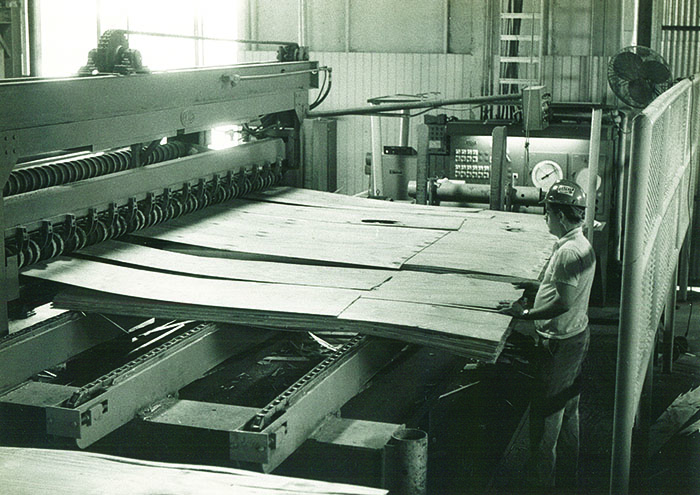
Our friends Dick Baldwin and Rich Baldwin write about the North America softwood plywood industry in this issue. They note that about 28 plywood mills disappeared since pre-recession or basically in the past dozen years, leaving 58 or so in operation. They note that Boise Cascade and Georgia-Pacific have the two largest softwood plywood capacities in North America. But things happen quickly in the plywood industry, and I believe it has been since they wrote the article that Georgia-Pacific closed its plywood mill in Warm Springs, Ga. and Boise Cascade sold its mill in Moncure, NC.

Upon hearing that GP had closed Warm Springs, the editors at Panel World began guessing how many softwood plywood mills GP has left. How many do you think? Here’s a hint: They are all southern pine plywood mills. Here’s another hint: The list doesn’t include GP’s original plywood mill site in Fordyce, Ark., which started up in 1964 and was recognized as one of the first three southern pine plywood mills to start up that year (along with Kirby’s mill at Silsbee, Texas and Temple’s mill at Diboll, Texas). Neither GP’s mill at Fordyce or its mill at Crossett, Ark., which started up in 1965, made it out of the recession.

Our best educated guess is that GP’s oldest softwood plywood mill site still in operation is at Emporia, Va. GP started it up in 1966. We think the next oldest GP site still going is Taylorsville, Miss., which started up in 1969. Third oldest GP site still producing plywood? Perhaps it’s Prosperity, SC, which began production in 1975.

So that’s three GP plywood mills still ticking. But there’s more. As best as we can tell, GP still has eight softwood plywood plants in operation. In addition to Emporia, Taylorsville and Prosperity, there’s Dudley, NC, which GP started up in 1980; and plants in Corrigan, Texas; Camden, Texas; Madison, Ga.; and Gurdon, Ark., none of which, we think, GP actually started up but rather purchased.

GP started up the recently closed Warm Springs mill in 1974. The next year GP started up a mill in Talladega, Ala., which GP idled during the recession, then closed in 2016. But the Talladega site has had a resurgence. After the site sat motionless for 10 years, GP has recently started up a new sawmill there, and in fact was able to restore a couple of the barrel buildings that housed the plywood mill. I visited the sawmill in January, and a local at a nearby convenience store told me they were never so glad as when the log trucks started rolling again.

Of course it’s easy for us to toss around mill statistics, but rest assured we’re very sympathetic to the fact that each time one of these mills closes it’s a major life altering episode for the workers and their families. Unfortunately, mill closures has become a fact of life in the plywood industry, but there are signs that this segment is stabilizing, and in fact new plywood mill production has even come on in the past couple of years.


Latest News

Vecoplan AG Announces New CEO

Vecoplan AG Announces New CEO Following Eric Jaschke's appointment to Chief Financial Officer (CFO) in December 2025, Vecoplan AG has also...

Find Us On Social

Newsletter

The monthly Panel World Industry Newsletter reaches over 3,000 who represent primary panel production operations.

Subscribe/Renew

Panel World is delivered six times per year to North American and international professionals, who represent primary panel production operations. Subscriptions are FREE to qualified individuals.

Advertise

Complete the online form so we can direct you to the appropriate Sales Representative. Contact us today!

The Year Of The Composite Board

The Year Of The Composite Board

The Year Of The Composite Board

Article by Rich Donnell, Editor-In-Chief, Panel World, January 2019

Plywood mill and OSB mill project startups in the U.S. have received a lot of attention during the past couple of years, and more are forthcoming this year, but 2019 has all the makings as the year of the composite board. Three upcoming board mill startups—with one occurring in each of the first three quarters—come quickly to mind.

Arauco is currently pushing through commissioning toward first quarter startup of its $400 million greenfield particleboard plant in Grayling, Mich. Situated on 160 acres, the 820,000 sq. ft. main building houses a 10 ft. wide by 172 ft. (52.5 m) continuous press and will produce more than 450MMSF annually, complemented by two lamination lines. Log intake began last September.

One of the cool things about this project is that Arauco has been very visible with its progress, sending out periodic updates with site photography and the status of equipment installation.

Swiss Krono is probably looking at a second quarter startup of its new $230 million HDF plant at Barnwell, SC. It’s expected to produce 170MMSF annually beyond what the existing plant there already produces. The new line will also operate a continuous press—this one 10 ft. by 101 ft. (30.5 m). The project has also added a fourth lamination line.

Expected to hit startup in the third quarter is the greenfield CalPlant I (CalAg) rice straw-based MDF plant in Willows, Calif. The $315 million plant will have a production capacity of 140MMSF annually.

Wait. Did I just say rice straw? I did, and it makes me think back to the mid 1990s when ag fiber surged out of the gate—the premise being that instead of farmers burning their crop waste and contributing to carbon dioxide and smoky haze, they could actually sell their waste to board manufacturers.

I visited several of those plants during startup back then—the PrimeBoard wheat straw particleboard plant in Wahpeton, ND; the Isobord wheat straw p’board plant in Elie, Manitoba; the Acadia Board sugar bagasse board plant in New Iberia, La. Prairie Forest Products started up a wheat straw board plant in Hutchinson, Kans. Some other companies built them and some companies announced they were planning to build them but never did.

Why did they fail? Expensive resin? Poor machinery? Weak market promotion and distribution? The scientists got it wrong?

It was about this time that the CalAg principals began researching rice straw MDF, following California state legislation that prohibited farmers from burning rice straw waste. CalAg never gave up on it, through years of trying to tie the financing shoestring but never able to tighten the loops.

At least not until last May, when the money did come together—the majority of it in revenue bonds and the rest in cash equity with an assortment of investors. This plant, too, will operate a continuous press—10 ft. by 116 ft. (35.4 m). The plant will process 275,000 tons of rice straw annually.

Maybe where others failed, this ag fiber plant has a strong sales agent going in, namely Columbia Forest Products, which was one of the minority investors.

Maybe all of those problems from 20 years ago have been solved.


Latest News

Vecoplan AG Announces New CEO

Vecoplan AG Announces New CEO Following Eric Jaschke's appointment to Chief Financial Officer (CFO) in December 2025, Vecoplan AG has also...

Find Us On Social

Newsletter

The monthly Panel World Industry Newsletter reaches over 3,000 who represent primary panel production operations.

Subscribe/Renew

Panel World is delivered six times per year to North American and international professionals, who represent primary panel production operations. Subscriptions are FREE to qualified individuals.

Advertise

Complete the online form so we can direct you to the appropriate Sales Representative. Contact us today!