Tenth PELICE Lives Up To Billing In Atlanta

Tenth PELICE Lives Up To Billing In Atlanta

TENTH PELICE LIVES UP TO BILLING IN ATLANTA

Known as “the last conference in the world,” PELICE provides boost of enthusiasm for all segments of the panel industry.
ATLANTA, Ga.
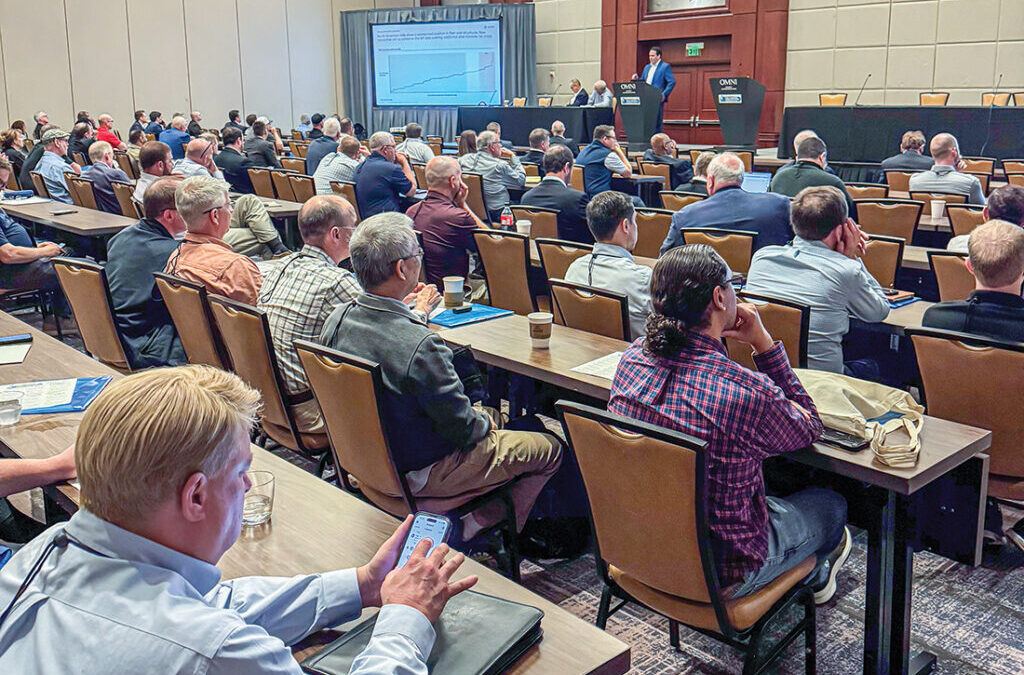
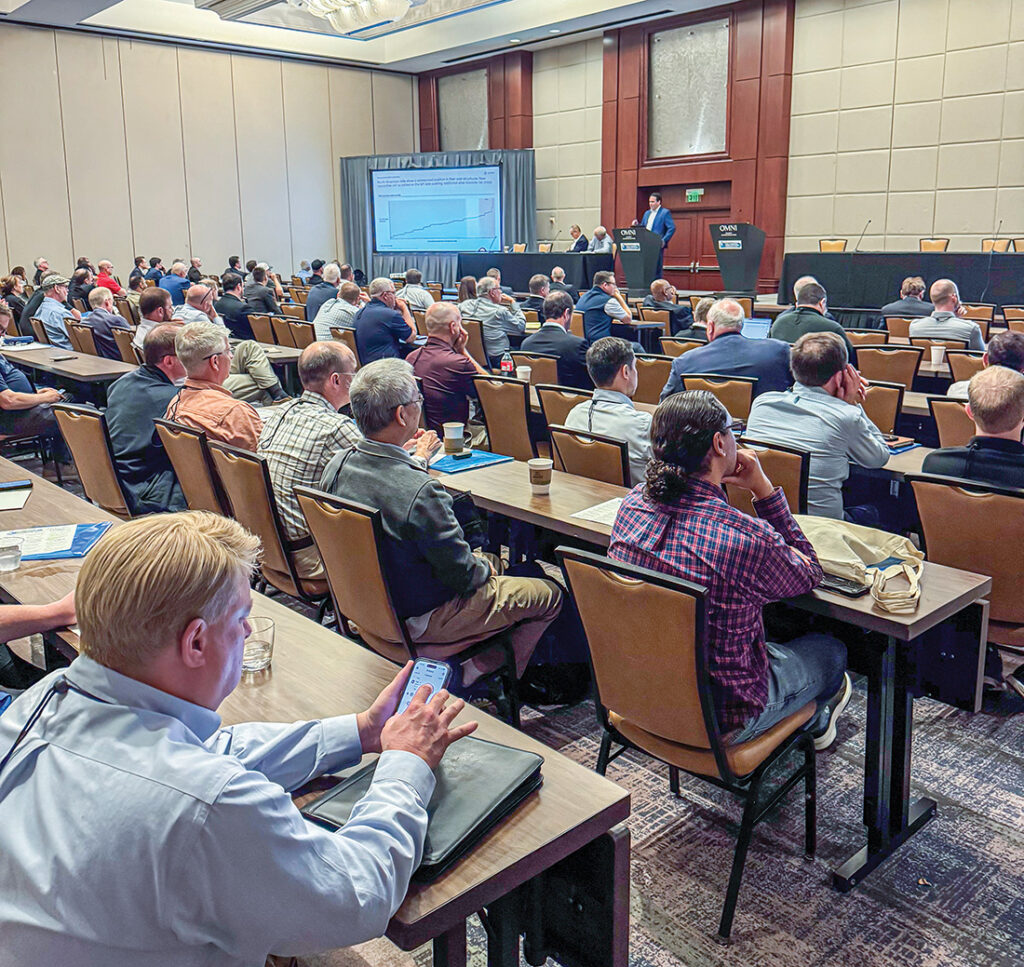
Forty-one speakers, 470 registrants and 95 exhibitors contributed to the 10th Panel & Engineered Lumber International Conference & Expo (PELICE) held April 16-17 at the Omni Atlanta Hotel at Centennial Park.

The event, which is co-hosted by Panel World magazine and Georgia Research Institute, is held every other year, with the first one occurring in 2008. That this was number 10 was an ongoing discussion, including the recognition of 18 exhibitor companies that have participated in all 10. 

During the opening session, PELICE Co-Chairman and Panel World Editor-in-Chief Rich Donnell recognized Co-Chairman and GRI President Fred Kurpiel as conceiving the idea of PELICE and approaching Donnell and Panel World for a partnership back in 2006.

Twenty-five producer companies sent management personnel to soak in the non-stop rush of information and technologies, and the event began with speeches from producer executives.

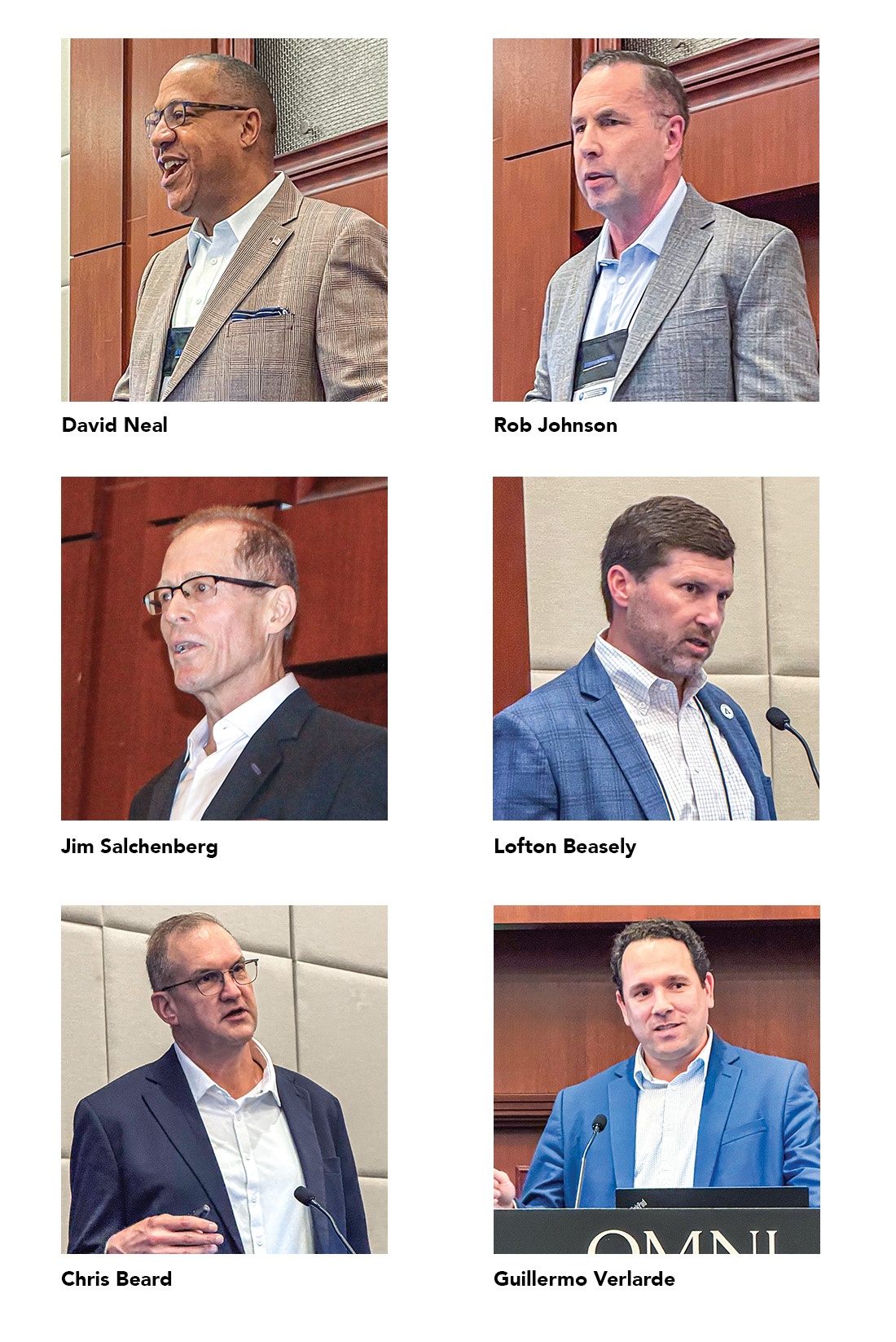
Three first morning keynote speakers addressed a full house in the Grand Ballroom North, leading off with David Neal, Vice President of Building Products at Georgia-Pacific; followed by Rob Johnson, Senior Vice-President of Manufacturing Operations at Boise Cascade; and Jim Salchenberg, Director of Strategic Projects at Roseburg.

A very active contributor himself to developments in Atlanta, Neal addressed GP’s longstanding role in the community and cultural affairs. He emphasized the importance of employee growth through a combination of in-house guidance and cultural awareness, leading to the building of relationships and trust in business and outside of business.

Neal, who has held numerous leadership roles at GP and started there in 1997 as a quality resource manager, focused on three GP people who have excelled with those principles, including Curley Dossman, President Community Programs, who leads GP’s charitable giving program and oversees the company’s community affairs efforts; along with Soy Sharjary, Vice President of Finance Building Products, who began with GP in 2003 as a lab technician; and Mark Atkins, Senior Vice President, Strategic Accounts.

Neal pointed to the three men and to GP overall as intertwining this model of community relationships and the on-the-ground betterment of the lives and awareness of the underprivileged, with building on efforts to not only establish partnerships and provide products to customers but to evolve with customers and provide new opportunities and capabilities that meet the changing needs of these “preferred partners.”

Boise Cascade’s Johnson spoke on the perhaps historically-based misimpressions of what Boise has truly evolved into today—one of the largest wholesale distributors of building products in the U.S., and one of the largest producers of LVL, I-Joist and plywood in North America with 18 manufacturing locations.

He said the company has resisted the urge to diversify its portfolio significantly, opting to remain with its expertise in an integrated framework regardless of market conditions. And he added that the distribution element stabilizes extreme swings in financial performance, providing margin consistency across market bounces.

More specifically to wood products, Johnson stated, “We are an EWP focused business. Our veneer mills also produce plywood, but we consider it a byproduct of strength rated veneer production.”

He said the business is geared to self-sufficiency of supply in veneer production—95% self-sustained in veneer in the West and 100% in the Southeast—supported by continued modernization of facilities.

Why EWP? Johnson said builders demand EWP in new home construction as a superior solution in consistency of design and building practice while reducing waste.

Only days after Roseburg announced it was resuming construction of a new MDF plant in Dillard, Ore., that project and others as part of a billion dollar capital investment program was addressed by Jim Salchenberg, Director of Strategic Projects at Roseburg.

Salchenberg noted that a stack of a billion one-dollar bills reaches higher than where commercial planes fly, and he added that the legacy of “big” at Roseburg was started by founder Kenneth Ford. Salchenberg said Roseburg approved more than 400 capital projects totaling more than $1.1 billion from 2021-2024. He said the new MDF mill in Dillard is planned for startup in late 2028, and is being built where the long-running now shuttered particleboard mill was.

Roseburg delivered the capital portfolio of projects within 3% of investment goals despite post-Covid challenges, according to Salchenberg, who provided three tips for budget control: Own the budget (manage every sub-cost within the budget); protect the scope relentlessly; and never accept “it takes what it takes, and it costs what it costs.”

Another keynote speaker from the producer sector, who spoke on the second morning of PELICE, was Lofton Beasley, Product Manager at Weyerhaeuser. He spoke on driving strategic growth for engineered wood products and innovative approaches to expanding engineered wood markets.

Beasley said there is a strategic urgency behind accelerating growth in EWP, emphasizing that structural changes in the construction industry are shifting demand away from traditional commodity products toward engineered, system-based solutions that deliver speed, predictability, and performance. Customers—ranging from builders to designers—are increasingly focused on solutions that mitigate labor shortages, reduce variability, and shorten build cycles. 

“These forces are structural, not cyclical, meaning they will persist regardless of short-term market fluctuations,” he said, adding that the opportunity for Weyerhaeuser is to improve its long-term earnings profile by leaning into differentiated engineered products that are less exposed to commodity price volatility. 

“The key executive message is that while housing markets may be volatile in the near term, strategic action must be taken now to position EWP as a durable growth engine that delivers sustained value creation across market cycles.”

Building codes and standards increasingly favor engineered solutions due to their structural performance and reliability, Beasley added. At the same time, persistent labor constraints and risk aversion among builders are accelerating the adoption of repeatable, prefabricated, and system-based construction approaches. 

Weyerhaeuser is adding to its engineered wood capacity in North America with the ongoing construction of a TimberStrand facility in Monticello, Ark. The new facility addresses underserved and growing market for TimberStrand in the U.S. South, Beasley said, and its enable conversion of lower quality southern logs and forest byproducts into a higher value EWP product, with 80% of raw material sourcing expected to come from company fee timberlands. The new facility will add 10 million cubic feet of products capacity and increase total company EWP capacity by 24%.

A post-lunch keynoter was Chris Beard, Vice President Building Products Research at John Burns Research and Consulting, who addressed the drivers impacting wood panel usage in housing.

Beard said building product spending will be $485 billion in 2026, down 0.6%, but while the market is essentially flat, it’s not necessarily static, as the mix of demand continues to shift.

He said new construction is “the near-term drag,” noting that the gap between unsold single family homes under construction and those completed remains large, with completed homes representing 27% of total inventory. He added that March single-family new home starts per community fell to the lowest March level in six years. Meanwhile, residential improvements spending continues to become more important, and is basically equal to the combination of new single-family homes and new multifamily homes.

Beard said the median U.S. home is now 44 years old, and new builds in the last 20 years represent just 16% of total stock. Homes built in the early 2000s construction boom now need significant upgrade.

While Beard expects a decline in single-family starts in 2026 of 2%, he does forecast a recovery in 2027, 2028 and 2029 of positive 4%, 3% and 4%, respectively. Multifamily will also decline in 2026 by 9%, followed by recovery of 8%, 7% and 7%.

He added that custom homebuilding starts have shown an uptick over the past few years, resulting in an increase to average home sizes. 

The real opportunity is in repair and remodeling, and one reason is that tax refunds this season are expected to be significantly larger than usual, providing a tailwind to remodeling. He says the number of homeowners in their peak remodeling years will grow slowly through 2028.

Also, home equity levels are near all-time high, far exceeding the peak of the 2000s housing bubble. Home equity-based financing is most often used for remodeling projects.

Another factor is “the disaster repair wild card.” Damages from billion dollar events are becoming more frequent over time.

Guillermo Velarde, principal at AFRY Management Consulting, addressed the big picture for structural and composite panel markets. 

With regard to OSB, he said capacity will increase in North America, but new capacities will put installed capacity at risk, all the while dependent on construction.

He said the ongoing substitution pressure from OSB, driven by cost advantages and better technical properties, is limited future demand growth of softwood plywood.

He noted particleboard is a very consolidated market in North America. Competitive exports from contemporary, large-scale European particleboard factories are increasingly challenging the older and smaller mills in North America. But total market potential surpasses installed capacity.

In MDF, new announced capacity is expected to be competitive against imports due to high efficiency and competitive raw material costs. 

AFRY recommends operational improvement of the plant, including process improvements, variable cost and energy savings, and if necessary organizational changes. It also recommends logistics and Supply Chain Management improvements, and profitability actions; and changes in raw material sourcing strategies on one end and product portfolio diversification on the other, and an overall review an enhancement of innovation strategy.

There was much more during PELICE, including major discussions on Artificial Intelligence, Catastrophe Management, Wood Fiber, Project Develoment, Production Improvements, Additives & Applications, Veneer & Plywood Manufacturing, Fire and Safety Technologies, Mass Timber, and Energy & Emissions.


Latest News

Forest Service Moves Forward With Disaster Recovery

Forest Service Moves Forward With Disaster RecoveryThe U.S. Forest Service announced that significant recovery efforts across national forests and grasslands continue to progress following damage caused over three years of natural disasters, including hurricanes,...

Manthei Wood Products Purchases Cahaba Veneer In Alabama

Manthei Wood Products Purchases Cahaba Veneer In AlabamaBibb County Economic & Industrial Development Authority (EIDA) announced that Manthei Wood Products, a nationally recognized, family-owned hardwood veneer manufacturer, has acquired Cahaba Veneer in...

Find Us On Social

Newsletter

The monthly Panel World Industry Newsletter reaches over 3,000 who represent primary panel production operations.

Subscribe/Renew

Panel World is delivered six times per year to North American and international professionals, who represent primary panel production operations. Subscriptions are FREE to qualified individuals.

Advertise

Complete the online form so we can direct you to the appropriate Sales Representative. Contact us today!


Forest Products Industry Says Goodbye To Walter

Forest Products Industry Says Goodbye To Walter

Forest Products Industry Says Goodbye To Walter

Article by Rich Donnell, Editor-in-Chief, Panel World March 2024

Article by Rich Donnell, Editor-in-Chief, Panel World


Walter Jarck, whose career in the forest products industry spanned 65 years and ranged from logging machinery to engineered wood products, died January 3, surrounded by his children, in North Wilkesboro, NC. He was 92.


Jarck spent the last two decades of his life trying build a high scale, commercial production TimTek (formerly Scrimber) composite lumber manufacturing facility, and nearly pulled it off; but long before then as a forest engineer he was a pioneer innovator of pulpwood loading and forwarding machinery, and log harvesting and processing machinery.


Jarck was born on May 7, 1931 in Queens, New York, and learned a hard work ethic from his immigrant parents. It was when he moved with his mother to the Catskill Mountains of New York that he fell in love with the woodlands.


He graduated in 1953 from the New York College of Forestry at Syracuse and entered Naval Officer Candidate School. He became a destroyer officer and ultimately retired from the Naval Reserves as a Captain. He recalled while in the Navy working with ships and mechanical, propulsion, steam and hydraulic systems.


Upon leaving the Navy he went to work for Caterpillar Tractor Co. as a logging engineer and spent a year in their sales training program and experienced the welding, mechanical and engine shops and was involved in the development of root rakes. “By the time I left I knew how a scraper was built, how a bulldozer was built, so I was really turned on by that,” Jarck said.


In 1958 he moved to the South and went to work as a forest engineer for Bowater, which was building a paper mill in Catawba, SC. “My boss said, ‘we have a six hundred million dollar paper mill being built and we’re going to be relying on the sweat of a few laborers to hand load and to bring wood in. There’s got to be a better way.’”


While Jarck was supervising the construction of buildings and wood yards for the new mill, he started looking at ways to mechanize logging equipment, which would alleviate the traditional practice of mills having to stockpile six months of logs in their wood yards to overcome the winter weather.


In the early 1960s Jarck led the development of the Go Getter pulpwood forwarder and in the mid 1970s working with Charles Allen the Allen Jarck Harvester for felling pulpwood and processing it into sticks, an early version of today’s cut-to-length machinery.


In 1982 Jarck joined Georgia-Pacific as assistant vice president and senior forester. He was involved in policy making and in several acquisitions. He retired in 1996 from Georgia-Pacific as corporate director of forest resources and then taught industrial forestry courses at the University of Georgia for several years.


Jarck was far from retired. In 2001 he and partner Geoff Sanderson acquired the world rights to the Scrimber technology from the Australia government interests that invented it in the mid 1970s. Scrimber was produced from small plantation trees to form a reconsolidated wood product with uniform properties comparable to sawn timber.


Jarck and Sanderson formed TimTek (they didn’t purchase the Scrimber name) and their newly formed company purchased the pilot plant in Australia and relocated it to the campus of Mississippi State University.


They wanted to build a true scale plant that would produce a product up to 48 in. in width, up to 6 in. in thickness and almost any length. TimTek beams, they said, would compete favorably in the large sizes for trusses, garage door headers, joists, rimboards and long-span structural timbers.


Jarck wrote: “Our process can best be summarized by crushing the debarked small diameter stems in a scrimming mill, then drying the scrim or mat of fibers, adding adhesives, collating the mats, steam pressing, then cutting to size and finishing. The resource can be softwood or hardwood in the 4-8 in. diameter classes. Resources of this nature are available at delivered prices that are one-fourth or one-fifth the cost of resources purchased in the sawtimber or veneer log categories.”

He also believed the TimTek products would satisfactorily counter the non-wood and steel framing increases in residential construction. “The steel stud manufacturers have somehow convinced the environmental home buyer that their steel product has lower impact on the environment than that of using wood,” Jarck said. “While we know this is false, a new product such as TimTek not only uses fast grown plantation trees, renewable every 10 to 12 years in the South, it is a lower user of energy and is a great carbon sequester.”

Jarck sub-licensed his product and technology to a company in Mississippi that publicly announced it was building a plant, but it never materialized. He thought he was close to another project in the Western U.S. and one in Canada, but they went away as well.


Jarck had married his high school sweetheart, Marilyn Matthews, on September 26, 1954, and they were happily married for 66 years. She passed away in 2020. They had five children, Lisa Arney, Nancy Clontz (Ted), Paul Jarck (Vicki), Laura Dennis and Chris Cunningham (Lance). They also had 12 grandchildren and eight great-grandchildren.

The family wrote upon Jarck’s death: “The words that best describe Walter are strong, determined, talented, and devoted. Walter was a strong leader and 1role model for his children, grandchildren and great-grandchildren. Walter was devoted to God and his family. He was a great man, loved by many, and will be truly missed.”

The family asked that in in lieu of flowers, memorials may be made to Wounded Warriors Project.

Latest News

Forest Service Moves Forward With Disaster Recovery

Forest Service Moves Forward With Disaster RecoveryThe U.S. Forest Service announced that significant recovery efforts across national forests and grasslands continue to progress following damage caused over three years of natural disasters, including hurricanes,...

Manthei Wood Products Purchases Cahaba Veneer In Alabama

Manthei Wood Products Purchases Cahaba Veneer In AlabamaBibb County Economic & Industrial Development Authority (EIDA) announced that Manthei Wood Products, a nationally recognized, family-owned hardwood veneer manufacturer, has acquired Cahaba Veneer in...

Find Us On Social

Newsletter

The monthly Panel World Industry Newsletter reaches over 3,000 who represent primary panel production operations.

Subscribe/Renew

Panel World is delivered six times per year to North American and international professionals, who represent primary panel production operations. Subscriptions are FREE to qualified individuals.

Advertise

Complete the online form so we can direct you to the appropriate Sales Representative. Contact us today!

. . . And Back In The U.S.

. . . And Back In The U.S.

. . .And Back In The U.S.

Article by Rich Donnell, Editor-in-Chief, Panel World July 2023

As has often been the case in my previous trips there, perhaps the leading topic of conversation at the Ligna show in Hannover, Germany in mid-May was the status of multiple new projects back in the United States, such as Roseburg’s new MDF plant in Oregon, Kronospan’s new OSB plant in Alabama, Hood Industries’ new softwood plywood mill in Mississippi and the discussion landed on some rumors that had been percolating.

I ran into a friend from the U.S. who is, how I can put this, “involved” in the panel industry. This person asked me if I had heard that Huber had selected a new location to build its next OSB facility. I told this person I hadn’t heard and asked where it was. “I can’t tell you,” this person answered. “Why not?” I asked. “Because the person who told me swore me to secrecy,” this person said. “I shouldn’t have even told you they had selected a location.” We laughed at the exchange. I mean, why not tell your most confidential information to the editor of a panel industry magazine?

“What letter does the state start with?” I asked with a chuckle. This person thought a moment, “Okay, it’s M.” In grade school I had learned a song in which you sang the names of the states in alphabetical order. “Alabama, Alaska, Arizona, Arkansas…” It was usually good for winning a beer in college when I pretended I didn’t know any such song but was just trying to recite the states in alphabetical order, purposefully stumbling over a state along the way as if I couldn’t quite remember it until miraculously coming up with it, much to the groans of my easily impressed peers.

My mind and memory quickly raced through the song: “Kentucky, Louisiana, Maine, Maryland, Massachusetts, Michigan, Minnesota, Mississippi, Missouri, Montana, Nebraska…”

It wouldn’t be Maine. Huber already had one there. Maryland, Massachusetts, nope. Michigan, possible, but unlikely. Minnesota, are you kidding me after what Huber just went through there? Mississippi, very possible, the state had come on like gangbusters with sawmills and plywood mills and apparently has timberland to spare. Missouri, negative. Montana, don’t think so.

“Mississippi,” I said. “Don’t say you heard it from me,” this person said. “I’ll never identify you,” I said, “except maybe by your initials…just kidding.”

Bernstein, Woodward and Watergate it wasn’t, but a couple of days later I did a Google search for Huber Mississippi. Lo and behold. There it was, not an official announcement from Huber, but a joint public notice from the U.S. Army Corps of Engineers and the Mississippi Dept. of Environmental Quality Control that Huber wanted to build an OSB plant in Shuqualak, Noxubee County, Mississippi, and the purpose of the public notice was to inform the public, I guess, that Huber wanted a permit in order to discharge fill material into some wetlands. It got much more specific than that, but my initial thought was didn’t Huber didn’t get enough of the wetlands thing during its effort to build an OSB plant in Minnesota before saying goodbye? I’m guessing the circumstances are much different this time.

I was able to pull together this information and get it on our news site online. About two weeks later, after I returned to the U.S. from Germany, Huber officially announced it was building its next OSB plant in Shuqualak, Miss. I owe my friend a beer.

Latest News

Forest Service Moves Forward With Disaster Recovery

Forest Service Moves Forward With Disaster RecoveryThe U.S. Forest Service announced that significant recovery efforts across national forests and grasslands continue to progress following damage caused over three years of natural disasters, including hurricanes,...

Manthei Wood Products Purchases Cahaba Veneer In Alabama

Manthei Wood Products Purchases Cahaba Veneer In AlabamaBibb County Economic & Industrial Development Authority (EIDA) announced that Manthei Wood Products, a nationally recognized, family-owned hardwood veneer manufacturer, has acquired Cahaba Veneer in...

Find Us On Social

Newsletter

The monthly Panel World Industry Newsletter reaches over 3,000 who represent primary panel production operations.

Subscribe/Renew

Panel World is delivered six times per year to North American and international professionals, who represent primary panel production operations. Subscriptions are FREE to qualified individuals.

Advertise

Complete the online form so we can direct you to the appropriate Sales Representative. Contact us today!

Time To Stretch The Legs

Time To Stretch The Legs

Time To Stretch The Legs

Article by Rich Donnell, Editor-in-Chief, Panel World May 2023

In May, I depart for my 17th consecutive Ligna in Hannover, Germany. If the pandemic hadn’t canceled the event in 2021, I suppose this would have been 18. Regardless, I’m sure by now you’re thinking this guy must be getting up in years.

I know there must be many other Americans who have a longer consecutive Ligna attendance streak than me. But I know of only one—Fred Kurpiel, who is co-chairman with me of the PELICE event held in the off-Ligna year, and who had stints with Siempelkamp and Imeas in addition to his long-ongoing academic and consulting work.

I also know of one person who also will be attending his 17th Ligna in a row—Cole Martin, sales manager at Dieffenbacher. In fact, Cole and I attended our first Ligna in 1989, and we met there when he was a product manager for Küsters and I was headstrong into moving Panel World onto the international stage. I remember the exact moment I met Cole on the Ligna floor, and we discovered we had each graduated from Auburn University— Cole in 1976 and me in 1977.

Ligna was also a first for Coe Manufacturing in 1989. That looks like VP Ralph Gage, who passed away seven years ago.

Looking back, it’s not surprising that I met Cole at Ligna in 1989, because I was making the rounds of all the continuous press manufacturers at the time. Continuous presses were coming on strong in the composite board sector, and Küsters was a continuous press pioneer, and at that Ligna it was emphasizing its new profile control system on its twofold design continuous press.

Siempelkamp made no bones about its priority at Ligna ’89, considering the theme of its display was “Continuous Pressing with Siempelkamp ContiRoll.” At least a dozen were in operation worldwide by then, including several at Louisiana-Pacific facilities in the U.S. A few years earlier, LP kingpin Harry Merlo had said to me of the continuous press, “It’s the thing of the future.”

Speaking of continuous presses, a lot of people at Ligna ’89 were speaking of the Bison Hydro-Dyn continuous press, and in particular about two of them nearing installment in the U.S. at a new particleboard plant in Mt. Jewett, Pa. called Allegheny Particleboard, the brainchild of forest products physicist Volker Stockmann, who almost brought in Weyerhaeuser as his partner, before that fell through, leading to General Electric as a major investor.

But by no means was my first Ligna only about continuous presses. Remember the spindleless veneer lathe? Raute had fine-tuned it enough by then to display and operate a 5 ft. production lathe on the show floor. It drew massive crowds.

I could go on and on, which back then Ligna seemed to do, while the late international sales rep for Panel World, Alan Brett, showed me the ropes. We didn’t have a booth for many Lignas, so we put on a lot of miles, during and after the show. Today, and for many of the previous Lignas, Alan’s son, Murray, and I have worked out of our booth, while Murray’s wife, Liz, has handled the booth duty.

We all hope to see you there.

Latest News

Forest Service Moves Forward With Disaster Recovery

Forest Service Moves Forward With Disaster RecoveryThe U.S. Forest Service announced that significant recovery efforts across national forests and grasslands continue to progress following damage caused over three years of natural disasters, including hurricanes,...

Manthei Wood Products Purchases Cahaba Veneer In Alabama

Manthei Wood Products Purchases Cahaba Veneer In AlabamaBibb County Economic & Industrial Development Authority (EIDA) announced that Manthei Wood Products, a nationally recognized, family-owned hardwood veneer manufacturer, has acquired Cahaba Veneer in...

USDA Finalizes National Environmental Policy Act Reform

USDA Finalizes National Environmental Policy Act ReformThe U.S. Secretary of Agriculture Brooke L. Rollins has announced the U.S. Department of Agriculture (USDA) has finalized a rule modernizing the National Environmental Policy Act (NEPA) regulations. This Final...

Rayonier Will Stay Rayonier 

Rayonier Will Stay Rayonier Rayonier will maintain the Rayonier name after a thorough review of alternatives following its recent merger of equals with PotlatchDeltic, while also introducing a new corporate logo that reflects a fresh brand identity for the combined...

Find Us On Social

Newsletter

The monthly Panel World Industry Newsletter reaches over 3,000 who represent primary panel production operations.

Subscribe/Renew

Panel World is delivered six times per year to North American and international professionals, who represent primary panel production operations. Subscriptions are FREE to qualified individuals.

Advertise

Complete the online form so we can direct you to the appropriate Sales Representative. Contact us today!

The Business At Hand

The Business At Hand

The Business At Hand

Article by Rich Donnell, Editor-in-Chief, Panel World January 2023

Some forecasts coming out of APA—The Engineered Wood Association annual meeting in October painted a rather bleak economics picture for 2023. It was no surprise, given the already downward trending in housing starts, the steady upticking in interest rates and the gradual decline in many panel prices toward pre-pandemic levels. Though a couple of attendees mentioned to me that they thought the outlooks came across a little too negatively. “We aren’t there yet,” a producer executive said to me. “We’re doing okay at the moment.”

But barring the unforeseen, 2023 stands to be a challenging year, with some producers weighing production reductions while mill expansions still wrestle with supply chain issues and for that matter decide they aren’t in a hurry anyway.

No doubt many operations are already catching their breath following the tremendous post-pandemic surge. Now it becomes a matter of tweaking and timing.

A soft market is a good time to assess how the operation and mill fared through the hard run during the up market. Certainly through good times or bad most operations have systems and programming, and human beings, in place to provide immediate data feedback, but there’s nothing like a deliberate analysis, the results of which can range from everything to the need for a piece of equipment, to updating systems, to adding QC personnel, to simply a new paint job.

As you take a deep breath is also a good time to analyze where your company or operation is culturally. Running flat out 24 hours a day can push cultural principles (except for safety we would hope) to the side, though ideally the perfect operation is one that can blend seamlessly full production and the cultural personality, or mission statement, you’ve defined for it.

Did your operation’s cultural goals or principles live up to themselves during the production boom? If not, what do you need to do to solidify or enhance them? While your mill is not pushing production is a perfect opportunity to refurbish your cultural identity, perhaps even reevaluate it and establish new parameters for it; or, if you haven’t already done so, start from scratch to being to implement a cultural spirit.

Before we know it, we assume anyway, the building products markets will rebound and the industry will be producing at Indy 500 speed once again; so now is the time to get everything in order in time to make the green flag and to be able to coast through the yellow flags and to be satisfied with how you’ve performed come the next checkered flag.

Latest News

Forest Service Moves Forward With Disaster Recovery

Forest Service Moves Forward With Disaster RecoveryThe U.S. Forest Service announced that significant recovery efforts across national forests and grasslands continue to progress following damage caused over three years of natural disasters, including hurricanes,...

Manthei Wood Products Purchases Cahaba Veneer In Alabama

Manthei Wood Products Purchases Cahaba Veneer In AlabamaBibb County Economic & Industrial Development Authority (EIDA) announced that Manthei Wood Products, a nationally recognized, family-owned hardwood veneer manufacturer, has acquired Cahaba Veneer in...

Find Us On Social

Newsletter

The monthly Panel World Industry Newsletter reaches over 3,000 who represent primary panel production operations.

Subscribe/Renew

Panel World is delivered six times per year to North American and international professionals, who represent primary panel production operations. Subscriptions are FREE to qualified individuals.

Advertise

Complete the online form so we can direct you to the appropriate Sales Representative. Contact us today!

. . . And Back In The U.S.

Panel Industry Moves Ahead

Panel Industry Moves Ahead

Article by Rich Donnell, Editor-in-Chief, Panel World November 2022

As I glanced through the pages of the six issues of Panel World in 2022, various news developments refreshed my memory, but underlying it all was just the fact that business for the most part was conducted as usual. That we were back to at least fairly normal hit home at the biennial PELICE in March in Atlanta, where the crowd was obviously enthusiastic to be back in the mainstream. Other events throughout the year proved it as well—from annual meetings to trade shows, and also because our editors were being welcomed back into the mills to work up articles. During the pandemic, we pieced together one article “virtually,” but it wasn’t nearly as good and detailed as doing it on site.

Here are some news items from 2022, in case you forgot:

One Sky Forest Products said it would locate a new OSB plant in Prince Albert, Saskatchewan.

A middle market private equity firm, One Equity Partners, purchased USNR.

—Several wood-based panel industry veterans came out against paperboard wall sheathing and its potential dangers during major storms.

—West Fraser purchased the idled OSB plant in Allendale, SC from Georgia- Pacific.

—GP announced plans to expand production capacity at its OSB plant in Alcolu, SC.

—Huber submitted a revised Environmental Assessment Worksheet to the city of Cohasset, Minn. regarding its proposed OSB plant.

—One Equity Partners equity firm purchased Oregon-based Rosboro.

—Tor Gustavsen, former managing director of Argos Solutions, died at 60.

—Eight keynote speakers, more than 50 presenters, 100 exhibitors and 450 participants made the eighth Panel & Engineered Lumber International Conference & Expo in Atlanta one of the best ever.

Freres Lumber of Lyons, Ore. changed its name to Freres Engineered Wood as part of its centennial celebration.

Boise Cascade acquired Coastal Plywood and its plywood mills at Havana, Fla. and Chapman, Ala. for $512 million.

—A Quebec-based forestry family— the Cossette family—said it is investing $180 million to restart the OSB plant at Wawa, Ontario.

—Scotch Plywood started producing veneer at its new facility in Waynesboro, Miss., after a fire had destroyed the existing one in early 2021.

Raute named Mika Saariaho as president and CEO.

—LP converted its mill in Houlton, Maine to siding production.

Pacific Woodtech acquired LP’s EWP division and three LVL/I-joist manufacturing facilities for $210 million.

George Weyerhaeuser Sr., former president and CEO of Weyerhaeuser and great-grandson of the founder, died at 95.

—Collins named Tom Insko as president & CEO, succeeding retiring Eric Schooler.

SmartLam announced plans to build a glulam facility in Dothan, Ala. to supply the mass timber industry.

—Siempelkamp named a new CEO and CFO, Martin Scherrer and Martin Sieringhaus, respectively.

—Construction continued at Martco’s new OSB plant in Corrigan, Texas, which will be the company’s second OSB mill at that site.

Latest News

Forest Service Moves Forward With Disaster Recovery

Forest Service Moves Forward With Disaster RecoveryThe U.S. Forest Service announced that significant recovery efforts across national forests and grasslands continue to progress following damage caused over three years of natural disasters, including hurricanes,...

Manthei Wood Products Purchases Cahaba Veneer In Alabama

Manthei Wood Products Purchases Cahaba Veneer In AlabamaBibb County Economic & Industrial Development Authority (EIDA) announced that Manthei Wood Products, a nationally recognized, family-owned hardwood veneer manufacturer, has acquired Cahaba Veneer in...

Find Us On Social

Newsletter

The monthly Panel World Industry Newsletter reaches over 3,000 who represent primary panel production operations.

Subscribe/Renew

Panel World is delivered six times per year to North American and international professionals, who represent primary panel production operations. Subscriptions are FREE to qualified individuals.

Advertise

Complete the online form so we can direct you to the appropriate Sales Representative. Contact us today!