
Dieffenbacher Emission Control Systems
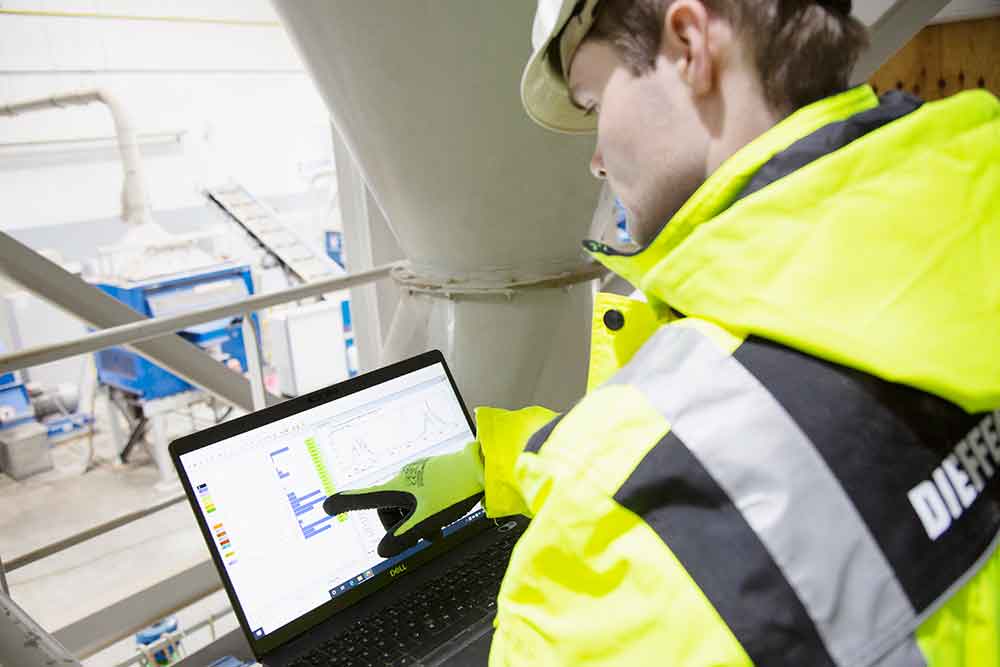
Dieffenbacher’s emission control solutions include emission measurements and dryer and press emission control systems. Emission measurements help plant operators understand which emissions are present and determine the type and amount of emissions. For example, using state-of-the-art methods, uncomplicated in-house emission measurements can be taken on stacks downstream of the dryer or the press exhaust system. This includes measuring parameters such as total organic carbon (TOC) and many different substances such as water, carbon dioxide, carbon monoxide, nitrous oxide, methane, ethane, propane, formaldehyde, methanol and other gases. Dust in the exhaust gas can also be measured using additional equipment. Subsequent correlation analyses of production parameters and emissions provide a better understanding of plant emissions.
The Dryer Emission Control System cleans dryer exhaust gases using an inline scrubber in compliance with local environmental standards. The main components are the unique inline scrubber and water treatment and distribution systems. The inline scrubber efficiently separates dust particles from the gas stream. Optional auxiliary equipment captures water-soluble VOCs, notably formaldehyde. The Dryer Emission Control System is applicable for horizontal and vertical operation and costs less than an electrostatic filter. It also impresses with its low freshwater demand, reliable design for high uptime and small space requirements.
The Press Emission Control System cleans exhaust gases from the press through a washing process. Dust and condensable fractions of exhaust gases are bound to fine water droplets. These solid and liquid parts are separated in the inline scrubber. Pre-Absorber units can be supplied to reduce VOC emissions (volatile organic compounds), particularly formaldehyde. As a fluid-optimized system, the Press Emission Control System is highly energy-efficient. Like the Dryer Emission Control System, it is characterized by low freshwater demand and small space requirements.
Latest News
Oregon Becomes First State To Legalize Mass Timber High Rises
Thanks to a recent addendum to Oregon’s building code, the state is the first in the country to allow timber buildings to rise higher than six stories without special consideration. Portland has become something of a hotbed for timber innovation as of late. Carbon12,...
Minnesota Looking To Attract Mass Timber Producers
A burgeoning industry based on a relatively new type of material may be coming to Minnesota. Known as mass timber, the material is an alternative to steel in building construction. While dozens of buildings constructed with the product are dotted around the country,...
Cross-Laminated Timber As A Forest Management Strategy
The state legislature earlier this year called on the Washington State Building Code Council (WSBCC) to adopt rules for cross-laminated timber (CLT) use when building residential and commercial buildings. The move represents ongoing efforts to bring CLT into...
RoyOMartin Announces $8 Million Upgrade, New Jobs At Louisiana Plywood Facility
Gov. John Bel Edwards and RoyOMartin President and CEO Roy O. Martin III announced the company will invest $8 million at its Chopin plywood and solid wood plant to install a new dry kiln designed to increase production. Additionally, the company will connect to...
Longtime Boise Cascade Manager Steve Stoler Retires
Steve Stoler will retire from his position as particleboard sales and marketing manager at Boise Cascade this August, marking the end of a 39-year career with the company. From the beginning of his career at Boise Cascade Company, Stoler has been a trailblazer. He...
Find Us On Social
Newsletter
The monthly Panel World Industry Newsletter reaches over 3,000 who represent primary panel production operations.
Subscribe/Renew
Panel World is delivered six times per year to North American and international professionals, who represent primary panel production operations. Subscriptions are FREE to qualified individuals.
Advertise
Complete the online form so we can direct you to the appropriate Sales Representative. Contact us today!