
Dieffenbacher Emission Control Systems
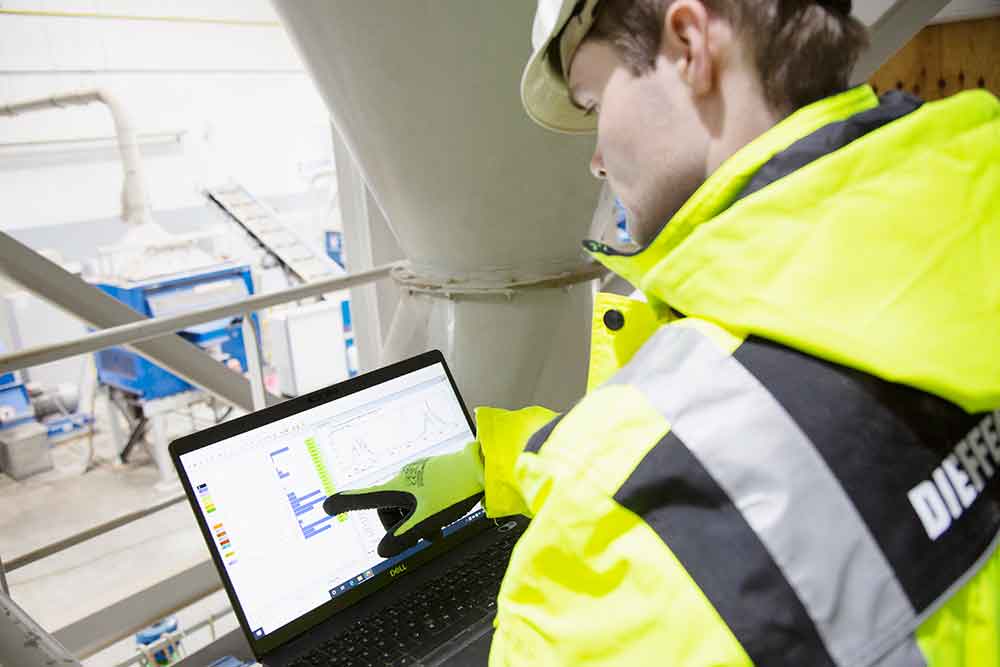
Dieffenbacher’s emission control solutions include emission measurements and dryer and press emission control systems. Emission measurements help plant operators understand which emissions are present and determine the type and amount of emissions. For example, using state-of-the-art methods, uncomplicated in-house emission measurements can be taken on stacks downstream of the dryer or the press exhaust system. This includes measuring parameters such as total organic carbon (TOC) and many different substances such as water, carbon dioxide, carbon monoxide, nitrous oxide, methane, ethane, propane, formaldehyde, methanol and other gases. Dust in the exhaust gas can also be measured using additional equipment. Subsequent correlation analyses of production parameters and emissions provide a better understanding of plant emissions.
The Dryer Emission Control System cleans dryer exhaust gases using an inline scrubber in compliance with local environmental standards. The main components are the unique inline scrubber and water treatment and distribution systems. The inline scrubber efficiently separates dust particles from the gas stream. Optional auxiliary equipment captures water-soluble VOCs, notably formaldehyde. The Dryer Emission Control System is applicable for horizontal and vertical operation and costs less than an electrostatic filter. It also impresses with its low freshwater demand, reliable design for high uptime and small space requirements.
The Press Emission Control System cleans exhaust gases from the press through a washing process. Dust and condensable fractions of exhaust gases are bound to fine water droplets. These solid and liquid parts are separated in the inline scrubber. Pre-Absorber units can be supplied to reduce VOC emissions (volatile organic compounds), particularly formaldehyde. As a fluid-optimized system, the Press Emission Control System is highly energy-efficient. Like the Dryer Emission Control System, it is characterized by low freshwater demand and small space requirements.
Latest News
New Company May Finally Give Relevance To Old Scrimber Technology Using Bamboo
New Company May Finally Give Relevance To Old Scrimber Technology Using Bamboo A bamboo engineered building product called GRASSBuilt is being manufactured at a small plant in Meridian, Miss. The patented technology, owned by TimTek, LLC and licensed to...
Milwaukee OKs Tallest Mass Timber Structure
The Milwaukee, Wisconsin city planning commission recently approved rezoning for a project many believe will be the tallest mass timber structure in the U.S., though the project must still be approved by a neighborhood zoning committee. Called the Ascent residential...
LIGNA 2019 – Wood Industry Summit
The Wood Industry Summit will be in its third season at LIGNA 2019, which runs from May 27-31 in Hannover, Germany. Staged in Hall 26 with the theme “Access to Resources and Technology," the summit is a well-established showcase for the forestry and wood industries....
Egger Gets Going On P’Board Plant
Egger Gets Going On P’Board Plant Egger reported in mid-November it has started construction on its first U.S. manufacturing plant. Construction of the particleboard plant in Lexington, NC began after the North Carolina Dept. of Environmental Quality (DEQ)...
The Year Of The Composite Board
Plywood mill and OSB mill project startups in the U.S. have received a lot of attention during the past couple of years, and more are forthcoming this year, but 2019 has all the makings as the year of the composite board. Three upcoming board mill startups…
Find Us On Social
Newsletter
The monthly Panel World Industry Newsletter reaches over 3,000 who represent primary panel production operations.
Subscribe/Renew
Panel World is delivered six times per year to North American and international professionals, who represent primary panel production operations. Subscriptions are FREE to qualified individuals.
Advertise
Complete the online form so we can direct you to the appropriate Sales Representative. Contact us today!