
Dieffenbacher Emission Control Systems
Dieffenbacher’s emission control solutions include emission measurements and dryer and press emission control systems. Emission measurements help plant operators understand which emissions are present and determine the type and amount of emissions. For example, using state-of-the-art methods, uncomplicated in-house emission measurements can be taken on stacks downstream of the dryer or the press exhaust system. This includes measuring parameters such as total organic carbon (TOC) and many different substances such as water, carbon dioxide, carbon monoxide, nitrous oxide, methane, ethane, propane, formaldehyde, methanol and other gases. Dust in the exhaust gas can also be measured using additional equipment. Subsequent correlation analyses of production parameters and emissions provide a better understanding of plant emissions.
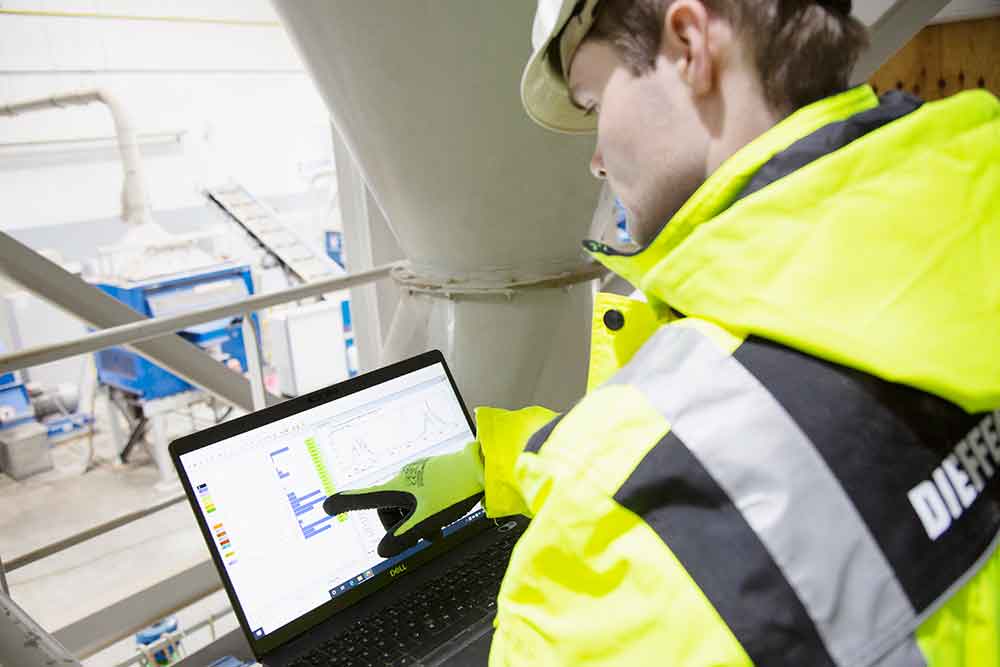
The Dryer Emission Control System cleans dryer exhaust gases using an inline scrubber in compliance with local environmental standards. The main components are the unique inline scrubber and water treatment and distribution systems. The inline scrubber efficiently separates dust particles from the gas stream. Optional auxiliary equipment captures water-soluble VOCs, notably formaldehyde. The Dryer Emission Control System is applicable for horizontal and vertical operation and costs less than an electrostatic filter. It also impresses with its low freshwater demand, reliable design for high uptime and small space requirements.
The Press Emission Control System cleans exhaust gases from the press through a washing process. Dust and condensable fractions of exhaust gases are bound to fine water droplets. These solid and liquid parts are separated in the inline scrubber. Pre-Absorber units can be supplied to reduce VOC emissions (volatile organic compounds), particularly formaldehyde. As a fluid-optimized system, the Press Emission Control System is highly energy-efficient. Like the Dryer Emission Control System, it is characterized by low freshwater demand and small space requirements.
Latest News
Washington State Creates Grad Scholarship In Maloney’s Name
From: Panel World Staff Washington State University is establishing the Thomas M. Maloney Graduate Scholarship through the Voiland College of Engineering & Architecture. Maloney, who died June 18 in Pullman, Wash. at age 83, was…
Structural Panel Production Rose
North American structural panel production increased 2.6% to 30.68 billion SF in 2014 compared to 2013. OSB production was up 6% to 19.88 billion SF, with U.S. production increasing 4.1% to 13.008 billion SF and…
Housing Starts Topped One Million
U.S. housing starts in 2014 totaled 1,005,800 million units, up 9% from 2013, marking the first time housing starts have surpassed 1 million since 2007 when starts exceeded 1.4 million units, according to a report…
Vienna Event Combines Conference, Expo, Tours
From: Panel World Staff The Vienna International Wood Products/Markets Conference, Expo & Tours will be held June 16-21 in Vienna, Austria. The event is organized by International Wood Markets Group, Inc. and Georgia Research Institute.…
Swanson Will Rebuild Springfield Plywood Mill
Officials with Swanson Group Mfg. LLC announced plans in January 2015 to rebuild the company’s Springfield, Ore. plywood plant that was destroyed by fire in mid-July 2014. According to Swanson Group President and CEO Steve…
Find Us On Social
Newsletter
The monthly Panel World Industry Newsletter reaches over 3,000 who represent primary panel production operations.
Subscribe/Renew
Panel World is delivered six times per year to North American and international professionals, who represent primary panel production operations. Subscriptions are FREE to qualified individuals.
Advertise
Complete the online form so we can direct you to the appropriate Sales Representative. Contact us today!