
Dieffenbacher Emission Control Systems
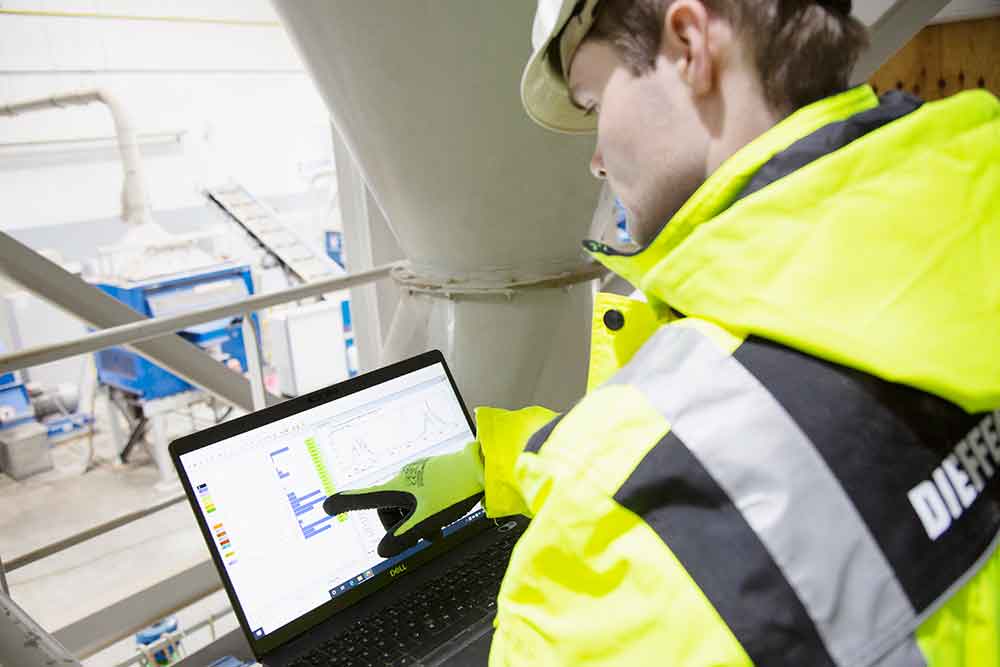
Dieffenbacher’s emission control solutions include emission measurements and dryer and press emission control systems. Emission measurements help plant operators understand which emissions are present and determine the type and amount of emissions. For example, using state-of-the-art methods, uncomplicated in-house emission measurements can be taken on stacks downstream of the dryer or the press exhaust system. This includes measuring parameters such as total organic carbon (TOC) and many different substances such as water, carbon dioxide, carbon monoxide, nitrous oxide, methane, ethane, propane, formaldehyde, methanol and other gases. Dust in the exhaust gas can also be measured using additional equipment. Subsequent correlation analyses of production parameters and emissions provide a better understanding of plant emissions.
The Dryer Emission Control System cleans dryer exhaust gases using an inline scrubber in compliance with local environmental standards. The main components are the unique inline scrubber and water treatment and distribution systems. The inline scrubber efficiently separates dust particles from the gas stream. Optional auxiliary equipment captures water-soluble VOCs, notably formaldehyde. The Dryer Emission Control System is applicable for horizontal and vertical operation and costs less than an electrostatic filter. It also impresses with its low freshwater demand, reliable design for high uptime and small space requirements.
The Press Emission Control System cleans exhaust gases from the press through a washing process. Dust and condensable fractions of exhaust gases are bound to fine water droplets. These solid and liquid parts are separated in the inline scrubber. Pre-Absorber units can be supplied to reduce VOC emissions (volatile organic compounds), particularly formaldehyde. As a fluid-optimized system, the Press Emission Control System is highly energy-efficient. Like the Dryer Emission Control System, it is characterized by low freshwater demand and small space requirements.
Latest News
North American Plywood Offers Digital Staining On Plywood
North American Plywood has launched DesignPly, a new panel offering based on a first of its kind digital staining technology. The highly-automated production incorporates a high-speed wide-array inkjet press engine paired with robotic materials handling…
Competition Drives Oregon Mill Investments
To be competitive in the wood products industry, companies must stay on the cutting edge. But to get to the forefront, wood products companies must invest in their production facilities to increase automation and efficiency,…
China Plywood Dumping Gets Third Review By International Trade Commission
The United States International Trade Commission says there is a “reasonable indication that a U.S. industry is materially injured by reason of imports of hardwood plywood from China that are allegedly subsidized and sold in…
Portland State University Tests CLT’s Seismic Strength
When the 12-story Framework building planned at Portland’s Northwest 10th Avenue and Glisan Street is complete, it may look to passers-by like any other Pearl District condo tower. But it will hold a special distinction…
New OSB Mill Still On Schedule
Work continues in Corrigan, Texas on a new oriented strandboard (OSB) manufacturing plant, the first such facility in the Lone Star State for RoyOMartin. Due to open in fall 2017, the plant represents a $280…
Find Us On Social
Newsletter
The monthly Panel World Industry Newsletter reaches over 3,000 who represent primary panel production operations.
Subscribe/Renew
Panel World is delivered six times per year to North American and international professionals, who represent primary panel production operations. Subscriptions are FREE to qualified individuals.
Advertise
Complete the online form so we can direct you to the appropriate Sales Representative. Contact us today!