Raute Group’s newly inaugurated Service Center is the company’s second Service Center in Russia. It was opened to ensure Raute’s capability to meet its customers’ needs better and serve the Kirov region plywood mills more effectively by offering shorter delivery times for spare parts and local services.
Within a radius of 400 kilometers, there are more than ten plywood mills that will be served in the first stage.
“The opening of the new Kirov Service Center marks an important milestone for Raute Service LLC in terms of providing local services to a growing veneer, plywood and LVL industry in the local market,” says Jouni Putkonen, Vice President, Market Area Russia (CIS).
“Raute’s strategy is to establish local service points close to its customers in order to be able to offer fast local service utilizing global knowhow – global presence, local service. The demand for technology services has increased strongly in recent years, which is why Raute Service LLC moved into larger and more professional premises in the beginning of 2017 in order to have more office and warehouse space. 2018 was a year of extensive service growth and this trend looks set to continue in 2019 and 2020,” says Tapani Kiiski, President and CEO, Raute Corporation.
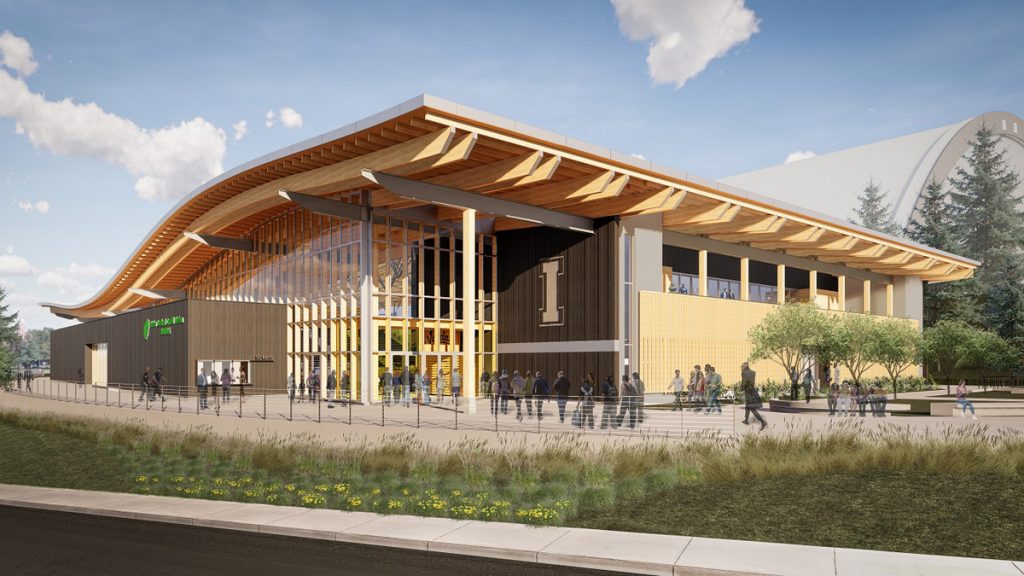
The 4,200-capacity engineered wood mass-timber facility is slated to open in 2021 as home court for Vandal basketball programs and campus and community events.
Planning for the structure has brought in wood industry partners from across the state to take part in the project. These critical partners support the building as an example of what can be done in the realm of modern wood construction.
U.S. Forest Service Chief Vicki Christiansen praises the wooden construction for it’s sustainability and the economic opportunities it creates.
“Every piece of timber from this building will be harvested from the state of Idaho,” says Isakson.
U.S. housing starts reached a seasonally adjusted rate of 1.415 million in September, a 1.9% increase above August and an 11.1% increase over September 2019….
Article by Rich Donnell, Editor-in-Chief, Panel World September 2020 – Every now and then a situation surfaces that is troubling to us. Elsewhere in this magazine you’ll read a news item about the…
G. Siempelkamp GmbH & Co. KG announced a restructuring program intended to help strengthen the company’s competitiveness in a difficult global market environment caused by the challenges that have arisen from the current pandemic…
Panel World is delivered six times per year to North American and international professionals, who represent primary panel production operations. Subscriptions are FREE to qualified individuals.
Tolko Industries announced its Armstrong and Soda Creek lumber operations would take downtime during the weeks of May 27 and June 3.
“High log costs and weak market conditions continue to impact our lumber operating footprint in British Columbia,” says Vice President of Solid Wood, Troy Connolly. “While we prefer to remain operational, we must manage the business responsibly and ensure we are sustainable for the long run.”
Connolly says employees were informed of the decision and local HR representatives are available to assist them with any questions they may have.
“We do not make these decisions lightly,” says Connolly. “We know we have great people working at these operations and this is in no way a reflection on them or their commitment. However, industry conditions in B.C. are challenging right now and could be for some time.”
Pino Pucci, Vice President, Tolko Marketing and Sales assured customers that Tolko’s Marketing and Sales team “will continue to support our customers and do our best to minimize any impacts as a result of these operations taking downtime.”
A 28-year
program to monitor logging Best Management Practices (BMPs) implementation on
east Texas timber harvest sites shows overall 93.8% BMP implementation in 2018
across all land ownerships.
That’s a solid improvement in the last 20 years—the
implementation rate was 87% in 1998—and remains at a high rate since the last
survey in 2015 when overall BMP implementation was 94%.
Every three years, the Texas A&M Forest Service conducts
BMP implementation monitoring on 150 randomly selected forested tracts across east
Texas where silvicultural activities occurred. The program is funded by Clean
Water Act Section 319(h) grants from the Environmental Protection Agency (EPA)
through the Texas State Soil and Water Conservation Board and seeks to measure
the degree of BMP implementation by forest landowners, silvicultural
contractors, forest industry and government agencies.
The recently completed round of monitoring covered sites in
33 counties between March 2017 and December 2018. Averaging all 150 scores,
overall BMP implementation on the sites was 93.8%. In general, implementation
was highest on sites under public ownership, with an overall implementation of
99%. Corporate lands (commercial landowners without wood processing facilities)
scored 95.3% overall, and family forest owners scored 91.1%.
As the program has consistently shown since its inception, the sites with the highest rates of BMP implementation were those where a forester was involved, the contractor had attended BMP training and the landowner was already familiar with BMPs. Other factors that boost BMP implementation are having BMPs in the sale contract, the timber purchased by an SFI mill, and a landowner forest management plan.
Overall BMP implementation has remained steady the last several years, the report says. The last time overall Texas BMP implementation fell below 90% was in 2000, at just under 89%. The highest recorded implementation rate so far in the program was 94.1% in 2011.
According to the report, most impressive is the considerable
progress demonstrated by family forest owners since monitoring began in the
early 1990s. This year, the 91.1% BMP implementation rate on family forest owner
sites represents a 31% increase since 1992. This improvement demonstrates that
ongoing education and training strategies geared towards loggers, landowners
and foresters were the driving force behind the increases in BMP implementation.
A Texas A&M on-line archive has an information-filled web
page detailing the program and a full lineup of every report beginning in 1992.
To find out more, visit https://tfsweb.tamu.edu/BMPMonitoring
The Michigan State University STEM Teaching and Learning Facility will be the first in Michigan to use mass timber wood products, rather than concrete and/or steel, for its load-bearing structure. The $100 million facility will be constructed of glue-laminated wooden columns and cross-laminated timber (CLT), a relatively new product for the floors and ceilings.
“We compared mass timber with other framing methods and were intrigued by how far wood has come as a building material,” said John LeFevre, MSU’s Planning, Design and Construction director. “A major advantage is the speed of construction – the panels can be assembled very quickly.” The new building will be constructed around the former Shaw Lane Power Plant. Two new mass timber wings will offer 117,000 sq. ft. of modern teaching labs, responding to STEM course demand, which has increased 40% in the last 10 years at MSU. The building is slated to open in fall 2020 with classes beginning in January 2021. The wood panels are being manufactured in Quebec and will arrive on campus in April.
Currently there is no CLT manufacturing in Michigan, although it’s a prime place for future development. In addition to economic development, the building will have environmental benefits, especially for locking up carbon that otherwise would be in the atmosphere and contributing to climate change. “I am excited to see the educational, research and outreach opportunities that the building itself promises to many academic units and to our land-grant mission,” says Ron Hendrick, dean of MSU’s College of Agriculture and Natural Resources. “It is an interdisciplinary platform encompassing forestry, construction management, biosystems engineering and beyond, and can serve as a catalyst to develop this new technology in Michigan.
“Having a CLT manufacturer in Michigan would not only create green jobs using sustainable resources, but also provide the financial resources and incentives that are needed to restore and conserve healthy, diverse and productive forests that provide so many other benefits,” says Debbie Begalle, state forester and chief of the Forest Resources Division of the Michigan Department of Natural Resources.
Homag Group is acquiring majority interest in the Danish mechanical engineering company, Kallesoe Machinery A/S, as Homag takes another step toward establishing…
Raute is moving its operations in China to a new location in Changzhou, which is in the Jiangsu province. The new facility is located three hours of driving time from Shanghai and there…
A “Silicon Valley” startup company that intended to redefine the methods of operation of the conventional housing and building construction industry has gone bankrupt and appears to…
RoyOMartin has announced a new production line for its Eclipse-branded OSB radiant barrier product at the Corrigan, Tex. facility. The Globe Machine Manufacturing Co. line, which will be…
Panel World is delivered six times per year to North American and international professionals, who represent primary panel production operations. Subscriptions are FREE to qualified individuals.