The Business At Hand

The Business At Hand

The Business At Hand

googletag.cmd.push(function() { googletag.display('div-gpt-ad-1548376180744-0'); });

Article by Rich Donnell, Editor-in-Chief, Panel World January 2023

Some forecasts coming out of APA—The Engineered Wood Association annual meeting in October painted a rather bleak economics picture for 2023. It was no surprise, given the already downward trending in housing starts, the steady upticking in interest rates and the gradual decline in many panel prices toward pre-pandemic levels. Though a couple of attendees mentioned to me that they thought the outlooks came across a little too negatively. “We aren’t there yet,” a producer executive said to me. “We’re doing okay at the moment.”

But barring the unforeseen, 2023 stands to be a challenging year, with some producers weighing production reductions while mill expansions still wrestle with supply chain issues and for that matter decide they aren’t in a hurry anyway.

No doubt many operations are already catching their breath following the tremendous post-pandemic surge. Now it becomes a matter of tweaking and timing.

googletag.cmd.push(function() { googletag.display('div-gpt-ad-1548375988914-0'); });

A soft market is a good time to assess how the operation and mill fared through the hard run during the up market. Certainly through good times or bad most operations have systems and programming, and human beings, in place to provide immediate data feedback, but there’s nothing like a deliberate analysis, the results of which can range from everything to the need for a piece of equipment, to updating systems, to adding QC personnel, to simply a new paint job.

As you take a deep breath is also a good time to analyze where your company or operation is culturally. Running flat out 24 hours a day can push cultural principles (except for safety we would hope) to the side, though ideally the perfect operation is one that can blend seamlessly full production and the cultural personality, or mission statement, you’ve defined for it.

Did your operation’s cultural goals or principles live up to themselves during the production boom? If not, what do you need to do to solidify or enhance them? While your mill is not pushing production is a perfect opportunity to refurbish your cultural identity, perhaps even reevaluate it and establish new parameters for it; or, if you haven’t already done so, start from scratch to being to implement a cultural spirit.

Before we know it, we assume anyway, the building products markets will rebound and the industry will be producing at Indy 500 speed once again; so now is the time to get everything in order in time to make the green flag and to be able to coast through the yellow flags and to be satisfied with how you’ve performed come the next checkered flag.

googletag.cmd.push(function() { googletag.display('div-gpt-ad-1589916740199-0'); });

Latest News

Tolko Announces Pino Pucci New President/CEO

After 14 years as president and CEO (CEO) of Tolko, and more than 40 years with the company founded by his grandfather Harold, Brad Thorlakson has transitioned to the role of executive chair of the…

New Combi-CLL Container

Following the launch of five new models in its 25th anniversary year in 2023, Irish material handling specialist Combilift has announced the launch of the new Combi-CLL (Container Log-Loader), a customer-led solution for the timber…

Smartlam Installs Ledinek Glulam Line

Slovenia-based Ledinek has embarked on a significant expansion across the Atlantic by supplying a new glulam production line to SmartLam North America for SmartLam’s mass timber manufacturing operation in Dothan, Ala. The SmartLam facility in…

Element5 Chooses Pinomatic For Glulam Expansion

Element5 Chooses Pinomatic For Glulam Expansion Pinomatic is delivering a glulam line and sorting line infeed to the Element5 mass timber facility in St. Thomas, Ontario. The project delivery in North American market represents yet…

Weyerhaeuser Names Brian Chaney To Lead Wood Products

Weyerhaeuser Co. has appointed Brian Chaney as senior vice president of Wood Products. Chaney recently served as vice president of Engineered Wood Products and Innovation for the company, and will take over for Keith O’Rear,…

Find Us On Social

googletag.cmd.push(function() { googletag.display('div-gpt-ad-1548376916922-0'); });
googletag.cmd.push(function() { googletag.display('div-gpt-ad-1548376961890-0'); });
googletag.cmd.push(function() { googletag.display('div-gpt-ad-1548377005333-0'); });
Newsletter

The monthly Panel World Industry Newsletter reaches over 3,000 who represent primary panel production operations.

Subscribe/Renew

Panel World is delivered six times per year to North American and international professionals, who represent primary panel production operations. Subscriptions are FREE to qualified individuals.

Advertise

Complete the online form so we can direct you to the appropriate Sales Representative. Contact us today!

Boise Cascade Announces New SC Distribution Facility

Boise Cascade Announces New SC Distribution Facility

googletag.cmd.push(function() { googletag.display('div-gpt-ad-1548376180744-0'); });

Boise Cascade has announced plans to expand its South Carolina operations with a new facility in Walterboro, with a $9 million investment that will create 30 new jobs. This new facility marks Boise Cascade’s first distribution location and second facility in South Carolina. Boise’s existing South Carolina facility is Chester Plywood, located in Chester.

Jeff Strom, Boise Cascade Co. Building Materials Division Executive Vice President, says, “We are excited to be planning a branch location in Colleton County. This investment demonstrates our commitment to a terrific customer base in a growing market.”

googletag.cmd.push(function() { googletag.display('div-gpt-ad-1548375988914-0'); });

Located in Colleton County, this facility will increase the company’s distribution capacity with direct access to the Palmetto Railways Salkehatchie Subdivision rail line, connecting Boise Cascade to the national freight rail network.

The Coordinating Council for Economic Development approved job development credits related to this project. A $200,000 Rural Infrastructure Fund (RIF) grant was also awarded to Colleton County to assist with the costs of site preparation and infrastructure improvements. South Carolina Secretary of Commerce Harry M. Lightsey III comments, “Congratulations to Boise Cascade Company, as it expands in another South Carolina location. Our state’s rural communities are producing and distributing products from some of the world’s most trusted companies, and we’re excited that the Walterboro community can add Boise Cascade to that roster. We look forward to supporting the company’s continued growth within South Carolina.”

googletag.cmd.push(function() { googletag.display('div-gpt-ad-1589916740199-0'); });

Latest News

Dieffenbacher To Supply Unilin Recycling Plant

In October 2024, Unilin and Dieffenbacher announced an agreement to introduce and further commercialize Unilin’s “Osiris” wood fiberboard recycling technology. Under this agreement, Dieffenbacher became the preferred partner for offering Osiris machine and equipment technology…

Buddy Douglas Retires From Scotch Plywood 

After 40 remarkable years in the timber industry, Buddy Douglas has officially retired as Plant Manager of Scotch Plywood. “Over his career, Buddy exemplified dedication, leadership and resilience, especially in the face of challenges like…

New OSB Project In Alabama Gains Permitting

Peak Renewables U.S. Inc. has received required permitting for the construction and operation of a greenfield 650MMSF oriented strandboard plant in Enterprise (Coffee County), Ala. Last February, the Enterprise City Council approved ordinances to convert…

Find Us On Social

googletag.cmd.push(function() { googletag.display('div-gpt-ad-1548376916922-0'); });
googletag.cmd.push(function() { googletag.display('div-gpt-ad-1548376961890-0'); });
googletag.cmd.push(function() { googletag.display('div-gpt-ad-1548377005333-0'); });
Newsletter

The monthly Panel World Industry Newsletter reaches over 3,000 who represent primary panel production operations.

Subscribe/Renew

Panel World is delivered six times per year to North American and international professionals, who represent primary panel production operations. Subscriptions are FREE to qualified individuals.

Advertise

Complete the online form so we can direct you to the appropriate Sales Representative. Contact us today!

China’s BFP Orders Fine OSB Plant

China’s BFP Orders Fine OSB Plant

googletag.cmd.push(function() { googletag.display('div-gpt-ad-1548376180744-0'); });

Chinese wood-based panel producer, A Beautiful Family Plate Making Co. Ltd. (BFP), has contracted with Dieffenbacher for a complete Fine OSB plant in Guangxi, China. Installation of BFP’s new plant is scheduled for the second quarter of 2023. The first board is expected to be produced in fall 2023.

Dieffenbacher will supply everything from chip flaking to raw board handling. The contract includes the dryer, screens, particle preparation and material recovery, glue preparation and dosing, gluing system, forming station and forming line, CPS+ continuous press system and electrics and plant automation. The plant will be able to produce 500,000 m³ of Fine OSB per year.

googletag.cmd.push(function() { googletag.display('div-gpt-ad-1548375988914-0'); });

“Fine OSB is increasingly popular in China,” comments Matthias Rübsam, Area Sales Director at Dieffenbacher. “The lower cost of the raw material makes OSB an economical alternative to plywood for almost every application. Fine OSB, however, overcomes traditional OSB’s poor laminating capability, caused by its uneven board surface.”

In Fine OSB, the OSB core layer is covered top and bottom by layers of particleboard to give a better structure to the top surface. This enables further processing, including laminating or coating on both sides with melamine or phenolic paper in a short-cycle press.

“Fine OSB combines the excellent mechanical properties of OSB, including moisture resistance, robustness, stable size and strong screw-holding force, but with the surface quality of particleboard,” Rübsam adds. “That makes it the perfect product for applications in home furnishings and decor, flooring, custom furniture making and many other areas. The Chinese authorities believe in the product so much that they’ve established a national standard for Fine OSB.”

googletag.cmd.push(function() { googletag.display('div-gpt-ad-1589916740199-0'); });

Latest News

Dieffenbacher To Supply Unilin Recycling Plant

In October 2024, Unilin and Dieffenbacher announced an agreement to introduce and further commercialize Unilin’s “Osiris” wood fiberboard recycling technology. Under this agreement, Dieffenbacher became the preferred partner for offering Osiris machine and equipment technology…

Buddy Douglas Retires From Scotch Plywood 

After 40 remarkable years in the timber industry, Buddy Douglas has officially retired as Plant Manager of Scotch Plywood. “Over his career, Buddy exemplified dedication, leadership and resilience, especially in the face of challenges like…

New OSB Project In Alabama Gains Permitting

Peak Renewables U.S. Inc. has received required permitting for the construction and operation of a greenfield 650MMSF oriented strandboard plant in Enterprise (Coffee County), Ala. Last February, the Enterprise City Council approved ordinances to convert…

Find Us On Social

googletag.cmd.push(function() { googletag.display('div-gpt-ad-1548376916922-0'); });
googletag.cmd.push(function() { googletag.display('div-gpt-ad-1548376961890-0'); });
googletag.cmd.push(function() { googletag.display('div-gpt-ad-1548377005333-0'); });
Newsletter

The monthly Panel World Industry Newsletter reaches over 3,000 who represent primary panel production operations.

Subscribe/Renew

Panel World is delivered six times per year to North American and international professionals, who represent primary panel production operations. Subscriptions are FREE to qualified individuals.

Advertise

Complete the online form so we can direct you to the appropriate Sales Representative. Contact us today!

First CLT Office Opens In DC

First CLT Office Opens In DC

First CLT Office Opens In DC

googletag.cmd.push(function() { googletag.display('div-gpt-ad-1548376180744-0'); });

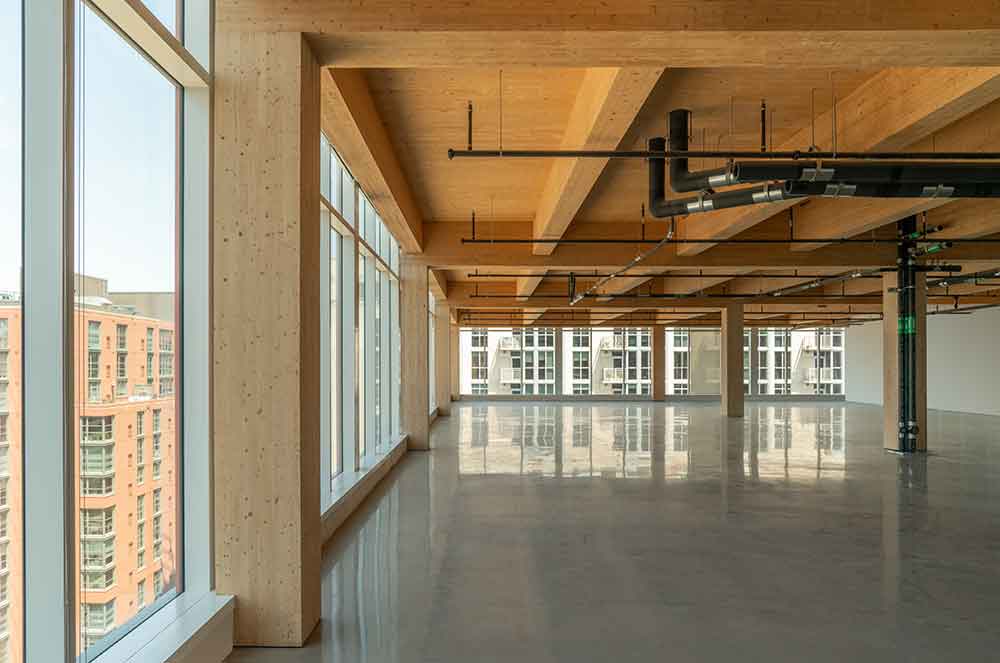
Opened in fall 2022, the first mass timber commercial building in the U.S. capital city features more than 108,000 sq. ft. of mass timber. The building is an innovative retrofit at 80 M Street SE in Washington, DC: Termed an overbuild—extra stories atop an existing building—the expansion features three floors, where columns of mass timber are visible from the interior.

googletag.cmd.push(function() { googletag.display('div-gpt-ad-1548375988914-0'); });

The project used 1,300 tons of CLT, with the mass timber addition sized at 108,000 sq. ft. of the overall 286,000 sq. ft. space. The developer of the project is Columbia Property Trust; architect is Hickok Cole. Engineering firm Arup performed the retrofit, and the property opened late September. First tenants are the American Trucking Assn. and BP America. Nordic Structures supplied the glulam beams and columns used in the project, and Katerra supplied the CLT.

googletag.cmd.push(function() { googletag.display('div-gpt-ad-1589916740199-0'); });

Latest News

Combilift Fundraiser For UNICEF Has Lots Of Winners

The Combilift Fundraiser in support of UNICEF has officially come to an end. Total tickets purchased, for a chance to win the 100,000th Combilift truck, raised more than €56,000 with Combilift proudly topping up that…

Weyco Wood Fiber Will Feed Aymium Biocarbon

Weyerhaeuser Co. and Aymium entered a memorandum of understanding (MOU) to partner to produce and sell 1.5 million tons of sustainable biocarbon annually for use in metals production. As an initial stage of this partnership,…

Find Us On Social

googletag.cmd.push(function() { googletag.display('div-gpt-ad-1548376916922-0'); });
googletag.cmd.push(function() { googletag.display('div-gpt-ad-1548376961890-0'); });
googletag.cmd.push(function() { googletag.display('div-gpt-ad-1548377005333-0'); });
Newsletter

The monthly Panel World Industry Newsletter reaches over 3,000 who represent primary panel production operations.

Subscribe/Renew

Panel World is delivered six times per year to North American and international professionals, who represent primary panel production operations. Subscriptions are FREE to qualified individuals.

Advertise

Complete the online form so we can direct you to the appropriate Sales Representative. Contact us today!

All Said And Done: Fifty Speakers Brought Their Expertise To PELICE

All Said And Done: Fifty Speakers Brought Their Expertise To PELICE

googletag.cmd.push(function() { googletag.display('div-gpt-ad-1548376180744-0'); });

PART FOUR: This is the fourth of a four-part series summarizing the presentations delivered during the Panel & Engineered Lumber International Conference & Expo (PELICE) held this spring and hosted by Panel World in Atlanta March 31 to April 1. The first three parts appeared in the May, July and September issues. PELICE 2024 will be held March 14-15, 2024 again at the Omni Hotel at CNN Center in Atlanta.

ATLANTA, Ga.

Anna McCann, president of Merritt Machinery and the U.S. representative of Meinan Machinery Works, led a panel session on recent installations of new Meinan lathe and composer technologies.

McCann first reviewed the history of Meinan, founded in Japan in 1953, and its numerous product innovations through the years, including random dry veneer composing, leading to the automated lathe line with in-line green veneer composing in recent years.

She cited the numerous advantages of the Meinan lathe line, including smoother veneer quality, higher recovery and energy savings, and pointed to attributes of the Meinan automated green end including no log spinouts, fully automatic knife changer, full sheet stacking by moisture content, automated clipping and in-line green veneer composing, including the “world’s first 10 ft. peeling line with in-line green composing.”

googletag.cmd.push(function() { googletag.display('div-gpt-ad-1548375988914-0'); });

Doug Pauze, president of Coastland Wood Industries, Nanaimo, BC, provided his insights on Coastland’s Meinan “hybrid” installation, including lathe and charger. He showed photos of the machinery installation and its successful integration into the downstream process.

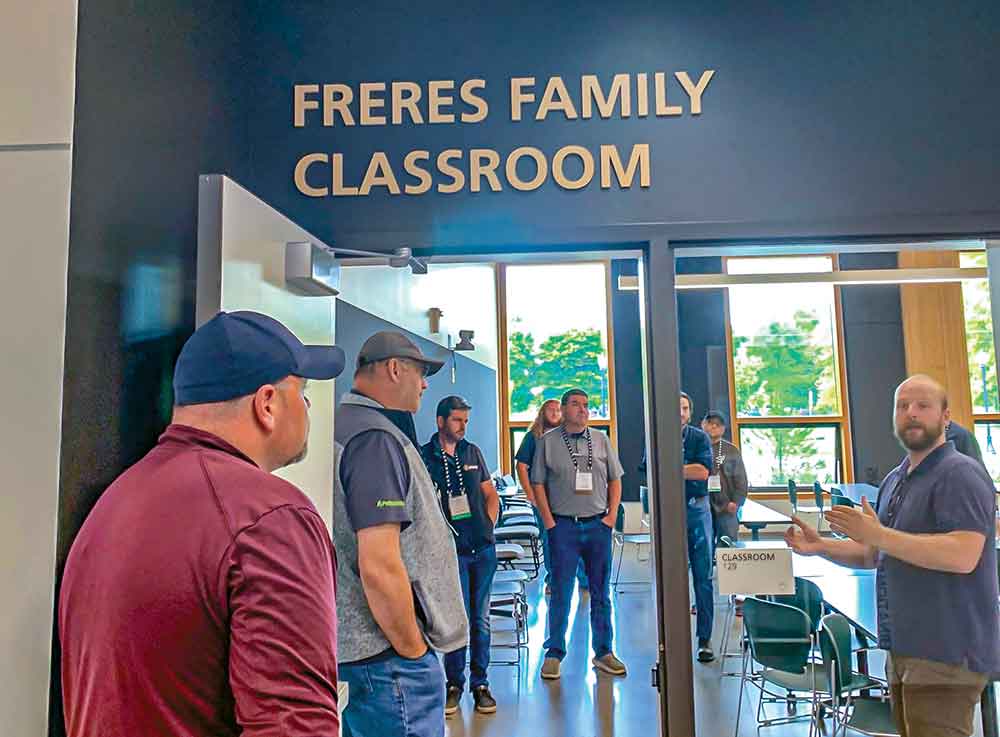
Rob Freres, president of Freres Engineered Wood, Lyons, Ore., discussed his company’s new Meinan 8 ft. green veneer composer installed in December 2021, which joins green or dry veneer.

He cited advantages such as preventing overlap defects in the core veneer, special heat activated paper tape providing a strong joint and staying on during the drying process. He noted minimal dryer shrinkage and no telegraphic transfer of tape to the face veneer.

Kevin Nesbit, national sales manager with Player Design, Inc. (PDI), spoke on innovative low ash biomass energy systems for wood products plants, and in particular about PDI’s burner technology.

He pointed to numerous features such as vertical combustion, center fed fixed grate slope circular burner (3200°F refractory bricks), screw augur feed, multi-stage combustion with customized air control, automatic ash removal, green or dry fuel, abort systems.

Nesbit reviewed several installed operations such as a new 45MM BTU green fuel combustion system at a 100% hardwood (shavings, sawdust chips) operation where the capacity of the dryer increased by 35% and emissions were reduced by 28%; and at a 100% southern yellow pine materials operation where

PDI technology replaced three dryers and dust furnace and has seen a 20% increase in plant productivity, running a new green fuel combustion system, 35MM BTU/hr and running 30,000 OD PPH. PDI technology enhancements have delivered stability in furnace and efficiency of combustion, lower CO emissions by more than 50%, less sparking and better drying control; as well as fuel flexibility, including utilization up to 60% MC. Each dryer or kiln can be supplied by an individual burner, allowing for continued plant operation of other dryers during maintenance or downtime.

Tom Wechsler, president of Wechsler Technologies & Engineering, spoke on his company’s new CenterFire wood fuel suspension burner.

Wechsler addressed the pros and cons of scroll and cyclonic suspension burners and why his company has developed a new burner, mainly because of existing older technologies, high frequency of shutdowns and limited combustion and temperature control.

The CenterFire is a compact design so it can fit in the space of most existing burners for easy replacement. Wechsler said other features included a centrally injected fuel stream to avoid contact with wall; various air zones to control temperature profile; multiple tangential air injection for effective film cooling of wall to prevent slagging; duel fuel flexibility if desired; minimal spark carryover; low emissions; advanced, multipoint temperature control; fully automatic PLC based control.

He said the potential annual cost savings of the CenterFire over conventional fines burners can top $830,000, especially due to less downtime and consequently less production loss; and also in refractory/relining savings and cleanout labor savings.

Raskesh Govind, president of PRD Tech, spoke on microemulsion assisted biotreatment of VOCs in exhaust gases. He pointed to traditional treatment technologies that consume substantial amounts of natural gas, which is increasing cost, and producing tons of carbon dioxide.

Microemulsion is a dispersion of a hydrophobic phase within water and this dispersion is stabilized by a surfactant/ co-surfactant; the hydrophobic phase has a high affinity for water insoluble VOCS, while the water phase has a high solubility for water soluble compounds, such as methanol.

Microemulsions result in lowering the Henry’s Law constant for water-insoluble VOCS, thereby lowering the liquid flow rates in the absorber, Govind said, adding that microemulsion abosorbers combined with bioreactors can biodegrade a wide variety of VOCS—water soluble and insoluble.

“The investment and operating costs for micoemulsion absorbers with bioreactors are substantially lower than” traditional methods, Govind concluded.

Grigorii Bunimovich, director at Matros Technologies, addressed RCOs, and in particular catalyst monitoring and maintenance. He pointed out that using catalysts in post-dryer RTOs provides substantial energy savings that well-justify the initial costs.

He said annual testing of worked catalyst samples generates recommendations on catalyst maintenance involving periodic regeneration via bakeout and gradual increase in RCO temperature.

He emphasized a new tubular reactor as part of catalyst activity testing that enables testing actual VOCs of interest with any type of commercial catalyst. The experimental destruction efficiency is close to one achieved in the RCO. He also pointed to the use of a stirred reactor for quick express testing with model VOCs.

Bunimovich said catalyst sample held for a year in the RTO operating after the wood dryer and WESP retains appreciable performance; and that for enabling catalyst application, the WESP should provide good PM removal and exclude liquid carryover.

More specifically he emphasized the efficiencies of base-metal catalyst that has demonstrated high efficiency for removal of methanol, formaldehyde and other HAPs and VOCs along with exceptional thermal resistance and high durability.

Steffen Bots, technical sales expert for Addinol Lube Oil, addressed the impact of friction on energy consumption. Looking at the big picture, Bots said 23% (119 EJ) of the world’s total energy consumption originates from tribological contacts (interacting surfaces in relative motion); 20% is used to overcome friction and 3% is used to remanufacture worn parts and spare equipment. By taking advantage of the new surface, materials, and lubrication technologies, energy losses due to friction and wear could be reduced by 40% in the long term (15 years) and 18% in the short term (eight years). “On global scale, these savings would amount to 1.4% of the GDP annually and 8.7% of the total energy consumption in the long term,” he said.

He specifically addressed challenges for lubricants in the wood panel industry, including operating conditions, production technology, variety of wood composition, and focused more on continuous presses, desiring minimized friction based on thicker lubrication film and friction modifier, and stronger wear protection by higher film thickness.

He pointed to a case study of a successful operation of continuous presses in Germany using Addinol Belt Lube HT, citing 30% less oil consumption due to optimal lubrication and 50% reduction of power consumption due to lower friction coefficient. He talked about Addinol lubricants (Eco Gear) for gearboxes, hydraulics, bearings and roller drums.

“Tribology is an underestimated discipline but is an important piece of the puzzle to more efficiency,” Bots said. “Lubricants are not the problem, they are part of the solution.”

Thomas Brotski, principal at Harrison Group, and Matt Cowen, sales manager with KCF Technologies, spoke on optimizing forest products mills and how industry leaders are reducing downtime, increasing throughput and driving industry 4.0 strategies.

They pointed to three challenges facing the industry that are driving the adoption of new technologies, including demand increase, cost reduction and talent shortage. They discussed value drivers such as optimization of maintenance through PM quality checks and prioritization, and optimization of machines through definition of optimal SOPs. They discussed the “right” technologies and process (wireless protocol/ shop floor machine learning/industrial grade hardware, etc.) from a dangerous and safe perspective. And concluded with the importance of personnel on the shop floor as part of the procedure from machine data to optimal plant operation.

Timothy Young, CEO and president of T.M. Young Institute and data scientist professor, spoke on the concept and use of Digital Twins as a key step in implementing machine learning and AL.

One key technology in ensuring success in implementing Industry 4.0 is supervised machine learning, Young said, enabling analyses of massive quantities of data. Digital twins mimic processes and human interactions by using simulations of the machine learning predictions— basically a virtual replica. For example, a control room operator relies on PLC logic from sensor data and human intuition from experience to optimize throughput while maintaining product conformance. A digital twin from machine learning algorithms mimics the decisions of control room operators for validation and may provide enlightenment for improved process optimization.

Young said “variable importance” is a key to digital twin development; that variation is cumulate, influences process targets, and is directly related to economic loss.

Wendy Owens, CEO of Hexas Biomass, discussed non-wood “green” boards and building materials. She defined “green” as better than netzero/ do-no-harm life cycle; locally sourced; protects and improves local ecosystems; and supports local communities. She said there is growing consumer demand for non-wood in combination with government promotion of “green” building materials.

She addressed the uses and advantages of several non-wood materials including coconut husk fiber, bamboo, hemp, and finally her company’s product, Xanograss, citing several benefits: low water use, climate resilience, no pesticides needed, no food crop displacement, EPA-approved, 15-year high yield from a single planting.

Further, she talked about hybrid or 100% Xanofiber particleboard and MDF meeting various standards in bonding, flexural property and water absorption, and as OSB with high resistance to mold and improved profile.

“Hexas’ goal is to make the highest and best use of all biomass,” Owens said. “We are developing IP, systems, and even a marketplace to do just that.”

Stefan Zöllig, principal at Timbatec Engineering, spoke about the dawning of a new day for an old product that has never come of age, at least not yet—Scrimber, as a carbon sequestering raw material for mass timber products.

He cited the well known climate and carbon advantages of wood over materials such as concrete, brick and steel. “How to do you produce building material out of CO2?” he asked, then answered, “Our forests do produce materials out of CO2,” which is one of the environmental attributes for the rising demand of timber buildings—public, residential and commercial. And he pointed to the ample yearly forest growth worldwide, of which sawnwood consumes only 10%.

Zöllig reviewed the production of Scrimber (now patented as the TimTek process) that originated with the Australia industrial research organization (CSIRO) in the 1970s, which entails basically crushing the log piece (scrimming) into interconnected strands, drying, resin application, drying, layup, pressing and cutto- finish as long fiber billets.

Zöllig pointed to CLT and glulam as potential markets and reviewed recent research efforts, feasibility studies and promised investor finances, and offered a roadmap to a pilot plant and a standard plant by the end of the decade.

Patrick Donahue, building products research program manager at Natural Resources Research Institute, addressed the charter mission of NRRI—to foster economic development of Minnesota’s natural resources in an environmentally sound manner and promote private sector employment. NRRI has significant research and lab locations at Duluth and Coleraine, Minn.

He spoke about the National Science Foundation’s Innovation Corps (I-Corps) seven-week hands-on course geared to the understanding and potential value of technology and assessing the market opportunity for new technology. The course environment is fast-paced; teams are pushed and challenged.

In 2021 Donahue was awarded an ICorps grant and his course team focused on the development of a business for a multi-functional building envelope panel solution. The team interviewed more than 140 stakeholders across all aspects of the building construction value chain.

He said several lessons were learned: the construction industry is extremely fragmented; some customer segments are not willing to pay more for environmentally sustainable building materials; if innovations are going to succeed, a comprehensive communication strategy is key.

Especially timely was Richard Poindexter’s talk on wood products employment trends and how to keep employees engaged. Poindexter is president of Search North America. He immediately caught everybody’s attention with a real world example of wood products companies having to compete with fast food restaurants that are paying workers $16-$18 an hour.

However, job opportunities abound in the wood products industry, from executive to entry level, due to COVID, the retirement of Baby Boomers, organizational realignment and simply people looking for new opportunities and having the leverage to do so. He said workers today want to earn a good salary, develop their skills, have flexible hours and feel appreciated.

How do you keep workers engaged? Poindexter pointed to cross training, employee survey feedback, educational reimbursement, bonuses, recreational perks and constant emphasis on their safety.

“Based on employment and demographic data this pattern of more jobs than people to fill them may last for a while,” Poindexter said.

googletag.cmd.push(function() { googletag.display('div-gpt-ad-1589916740199-0'); });

Latest News

First Full CLT Building In California Opens

The ribbon cutting ceremony by the Plumas County Health and Humans Services Department for its new Biomass Boiler Building in Quincy, CA on April 6, marked the opening of the first building in California made…

Hermal Announces Hardwood CLT Mill

Forest Industries Assn. of Tasmania (FIAT) and Australian Forest Products Assn. (AFPA) announced that Hermal Group is building a $190 million hardwood sawmill and hardwood cross-laminated timber complex in Burnie in northwest Tasmania, Australia. It…

PELICE Remembers

During the second Panel & Engineered Lumber International Conference & Expo back in 2010, while moderating a keynote speaker session, conference co-chair Fred Kurpiel mentioned several industry figures who had passed away since the previous…

CPA: Quick Guide To The EPA Formaldehyde Regulation

If you manufacture finished goods that contain particleboard, medium density fiberboard (MDF) or hardwood plywood (HWPW), then you likely have been preparing to comply with the Environmental Protection Agency’s (EPA’s) Formaldehyde Emissions Standards for Composite…

Katerra Receives $865 Million To Fund Massive CLT Plant

Katerra, a high-tech construction firm, has secured $865 million in funding from SoftBank Vision Fund. That money will go toward ongoing projects in the U.S., like the company’s planned cross-laminated timber plant in Washington, as…

CLT Panel Fails During OSU Construction Project

From: Panel World Editors Officials with Oregon State University are investigating a construction incident when a CLT panel failed in mid March at a campus building project. A 4×20 ft. panel, part of the sub…

Boise Cascade Acquires Tennessee Distributor

Boise Cascade Company is acquiring Lumberman`s Wholesale Distributors, a Nashville, Tenn.-based distributor of engineered wood products, commodity lumber items, and specialty building materials. The acquisition is expected to be complete in the coming weeks. Terms…

Weyerhaeuser Posts Growth From Wood Products

Weyerhaeuser has announced that its Wood Products division ended the fourth quarter of 2017 with much better revenues and earnings than one year earlier. Average sales prices had increased in all product segments, with the…

Roseburg Forest Products To Acquire Canada’s Pembroke MDF

Oregon-based Roseburg Forest Products recently reached an agreement in principle with Pembroke MDF, Inc. to purchase Pembroke’s medium density fiberboard (MDF) and molding production facilities located in northeastern Ontario, Canada. Upon final due diligence and…

Oregon Judge Rules Immunity No Defense

An Oregon district judge has refused to dismiss a 2016 lawsuit filed by counties with state forests within their borders that claimed state officials have refused to maximize timber revenues from lands that counties donated…

To MPP Or CLT? That Is The Question

Article by Rich Donnell, Editor-In-Chief, Panel World March 2018 It’s no coincidence that Freres Lumber’s new Mass Plywood Panel (MPP) plant in Lyons, Ore. is the cover story of this issue—the same issue that is…

HPVA Rebrands As Decorative Hardwoods Association

Hardwood Plywood & Veneer Association has just rebranded as the Decorative Hardwoods Association and launched an easy-to-navigate website packed with resources for trade professionals, manufacturers, and consumers. “This name change will better describe our diverse…

Norbord Posts Record Year In 2017

Panel producer Norbord has posted record earnings in 2017 for its worldwide business. The company also achieved record production at nine of its 15 mills, while the Inverness OSB expansion project was also completed. Peter…

Find Us On Social

googletag.cmd.push(function() { googletag.display('div-gpt-ad-1548376916922-0'); });
googletag.cmd.push(function() { googletag.display('div-gpt-ad-1548376961890-0'); });
googletag.cmd.push(function() { googletag.display('div-gpt-ad-1548377005333-0'); });
Newsletter

The monthly Panel World Industry Newsletter reaches over 3,000 who represent primary panel production operations.

Subscribe/Renew

Panel World is delivered six times per year to North American and international professionals, who represent primary panel production operations. Subscriptions are FREE to qualified individuals.

Advertise

Complete the online form so we can direct you to the appropriate Sales Representative. Contact us today!