by Web Editor | May 22, 2018 | News
USDA Forest Service Interim Chief Vicki Christiansen recently announced the award of almost $8 million to expand and accelerate wood products and wood energy markets. The Wood Innovation Grants will stimulate the removal of hazardous fuels from national forests and other forest lands to reduce the risk of catastrophic wildfires, promote forest health, and reduce the cost of forest management. The investment of federal funds will leverage over $13 million in matching funds from 33 business, university, nonprofit, and tribal partners in 20 states for a total investment of over $21 million.
“These Wood Innovation grants advance state-of-the-art solutions to reducing wildfire risk and making our forests healthier and more resilient,” said Forest Service Interim Chief Christiansen. “The public-private partnerships leveraged with these grants also foster increased economic development in rural communities.”
Previous grants supported successful blast testing of cross-laminated timber (CLT) that directly resulted in the Department of Defense using CLT on its on-base hotels; and the funding of a feasibility analysis for a new CLT manufacturing facility to increase the amount of U.S.-made CLT.
This year the Forest Service received 119 proposals, demonstrating the expanding interest in using wood in both traditional and unconventional ways, such as an innovative building material and as a renewable energy source. Since 2005 more than 260 grants have been awarded to improve forest health, create jobs, invest in renewable energy, and support healthy communities.
Of the 34 projects funded in 2018, 28 focus upon expanding markets for wood products, and six seek to increase markets for wood energy. Some examples include utilizing small-diameter woody material in cross laminated timber (CLT) panels, addressing affordable housing in the northeast building market with mass timber, converting woody debris to renewable natural gas for transportation fuel, and using juniper biomass and biochar to filter heavy metals and manage storm water.
Read more on this from the USDA Forest Service at https://www.fs.fed.us/news/releases/usda-forest-service-awards-wood-innovation-grants-expand-and-accelerate-wood-products.
by Web Editor | Sep 6, 2017 | News
Norbord is buying up wood burned by the Gustafsen wildfire. A local logging contractor, Rod Dillman, is the first to begin harvesting in the Gustafsen fire area, says Mike Kennedy, Woodlands Manager with Norbord in an email. He adds that there are some unique challenges logging burned wood.
“According to Rod, a primary challenge in logging the burned wood is the increased maintenance needed on his machines. There is a lot of ash dust which, even more than ‘normal’ dirt, tends to stick to surfaces and must be washed off rather than just wiped. It also makes it necessary to change air filters more frequently. Finally, carbon in the ash is hard on the knives used in the harvesting equipment. Rod also states that they are learning as they go, as this is the first time he has operated in such a large area of scorched timber.”
Kennedy says that luckily there are a few things that have moderated the effect of the fires on the trees, meaning most of the wood is still intact underneath the bark. “Certain species, for example, Douglas-fir with its thick bark, have evolved to withstand the effects of fire, which is a common natural event in the areas where it grows. Fire intensity was not uniform across the landscape, so in many places, trees were scorched on the bark only with minimal damage to the underlying wood. Entire trees are not necessarily affected, with more damage occurring in the bottom portion. It is often possible to buck this out with log processors at the roadside. Processing pressure can be increased to remove most of the severely burned bark or wood.”
They take pride in their adaptability to make the most of the fiber available and are very experienced using dry pine beetle killed wood, he says. “Norbord maintains the highest quality standards for our products and these standards are ensured through third-party certification by APA – The Engineered Wood Association. We have been able to use burned wood in the past.”
From 100 Mile Free Press: https://www.100milefreepress.net/news/norbord-starts-logging-burned-wood/
by Web Editor | Jul 24, 2017 | News
It’s been 20 years since the first containers of AraucoPly plywood made their way from Chile to the United States in 1997. Arauco celebrated the anniversary in a special event held at its booth during AWFS Fair 2017.
The company said despite temporary setbacks caused by the economic downturn in 2008 and a wildfire that devastated one of its manufacturing plants in 2012, AraucoPly has made giant strides in growing its customer base throughout the United States and Canada. Michael Vincent, director of Import Panels – Arauco North America, noted that the United States and Canada now account for 40 percent of AraucoPly’s worldwide sales.
The plywood panels are made from 100 percent radiata pine, grown in the company’s own FSC-certified, sustainably managed forests and composed of cores using exterior PF resins for flatness and stability, Arauco said.
As part of the anniversary, Arauco is introducing factory-primed AraucoPly panels at the 2017 AWFS Fair in booth 4609. Primed AraucoPly Siding, Beaded and Sanded products are offered with a consistent, full-coverage prime on five sides (edges included) and a smooth, sanded back. The company says the primed option was introduced in response to growing market demand for the time-saving advantage of a factory-primed wood surface.
Also featured at AWFS, Arauco’s Prism TFL collection has expanded its North American distribution of the exclusive Taction Oak collection. The company says the oak’s natural characteristics are captured and replicated using Embossed in Register (EIR) technology, resulting in a finished panel that rivals the look and feel of wood. Offered in five contemporary colors, Taction Oak coordinates with Prism Accentz neutrals. The Prism collection features more than 80 styles, including 59 exclusive designs.
From Woodworking Network: https://www.woodworkingnetwork.com/awfs/awfs-news/araucoply-commemorates-20-years-north-america
by Site Manager | Aug 18, 2011 | Taking Stock
Story by Dan Shell,
Managing Editor
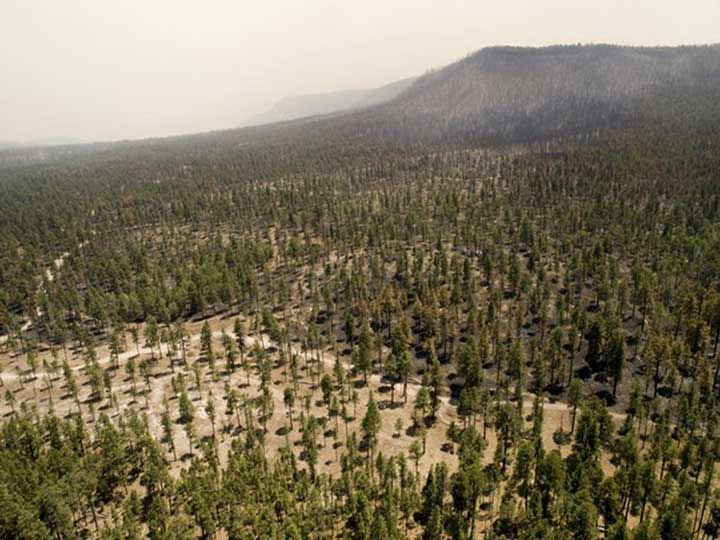
Two months ago in this space I wrote about the lost opportunity reflected in the flames consuming northern Arizona’s pine forests, where the Wallow Fire was making national news as it spread to become the largest ever in the state and burned almost 600,000 acres before it was contained.
The column mentioned the Arizona-based Four Forests Restoration Initiative, a Forest Service project that seeks to treat forest health concerns on 2.4 million acres over the next 20 years, in the process producing a mountain of low-quality logs and biomass. Too late to make the issue deadline, project leader Henry Provencio of the FS responded to an email and confirmed PW’s position—that the biggest obstacle to the project’s full implementation and success is the lack of local markets for the material to be utilized as small sawlogs, board furnish or biomass.
Provencio noted that “demand for our, primarily, small trees has not been what we hoped, so implementation has been slow and expensive. In response to the situation, we asked industry what was needed for them to move back to northern Arizona. The reply was a long-term commitment of supply, sufficient to meet the investment we are asking them to make. In order for us to meet that kind of commitment and just as important, to meet the restoration needs of our forests we had to go big.”
Now, recent research completed by the FS and published in Canadian Journal of Forest Research shows that aggressive thinning treatments are the most effective in reducing the probability of crown fires in the Western U.S., with fuel treatments that leave 50-100 trees/acre the most effective.
Though the optimal number of trees/acre varies by site, species, terrain and other factors, the study shows that “Once again, an ounce of prevention equals a pound of cure,” says FS Chief Tom Tidwell. “Thinning dense forests reduces the impacts of the catastrophic wildfires we’ve already seen this year and…helps protect communities, provides jobs and promotes overall better forest health.”
Tidwell noted that while 38 structures burned during the Arizona wildfires, thousands more were saved by fuel treatments implemented by federal, state and local agencies and private citizens that successfully reduced fire behavior. Computer simulations used in the study evaluating multiple treatment types and stand densities showed that the most intense treatments were more effective in reducing the threat of crown fires.
Of course, having the information and knowledge acquired from research and using it the right way are two different things. Here’s to hoping the FS can use the study results to aid in the implementation of its long-term forest health project in Arizona that has the potential to create new jobs while promoting forest health.