by Web Editor | May 20, 2016 | News
The U.S. Department of Agriculture’s Forest Service Chief Tom Tidwell today announced over $8.5 million to expand and accelerate technologies and strategies that promote the use of wood in commercial construction, heat and power generation, and other wood product innovations that also benefit forest health. Federal funds will leverage more than $18 million in investments from 42 business, university, nonprofit and Tribal partners in 19 states, for a total investment of $27 million.
“We are looking for opportunities to reduce forest restoration costs and create more jobs through strong forest products markets,” said Chief Tidwell. “This funding supports improving forest health on the National Forest System lands and other forested lands and promotes the economic and environmental well being of rural communities.”
The awarded funds will stimulate the use of hazardous fuels from National Forest System lands and other forested lands to promote forest health while simultaneously generating rural jobs. This year, 77 proposals were received for the Forest Service’s Wood Innovations grant program, highlighting the expanding interest and use of wood as a renewable energy source and as an innovative building material.
Healthy markets for forest products help the nation’s forests mitigate some of the impacts of climate change. Research has demonstrated that wood products from responsibly managed forests outperform other building materials in measures of greenhouse gas intensity, air and water pollution and other environmental impacts. Responsibly-sourced forest products also provide income for private landowners that keep their land forested and supports needed investments in forest management to provide clean water, wildlife habitat, and other resources millions of Americans depend upon.
Today’s announcement supports USDA’s Building Blocks for Climate Smart Agriculture and Forestry-a comprehensive effort to provide America’s farmers, ranchers and forest landowners with the tools and resources they need to combat climate change. Through this work, USDA expects to reduce net emissions and enhance carbon sequestration in soils and forests by over 120 million metric tons of CO2 equivalent per year by 2025-the equivalent of taking 25 million cars off the road or offsetting the emissions produced by powering nearly 11 million homes each year.
From the USDA: https://www.usda.gov/wps/portal/usda/usdahome?contentid=2016/05/0115.xml&contentidonly=true
by Site Manager | Aug 18, 2011 | Taking Stock
Story by Dan Shell,
Managing Editor
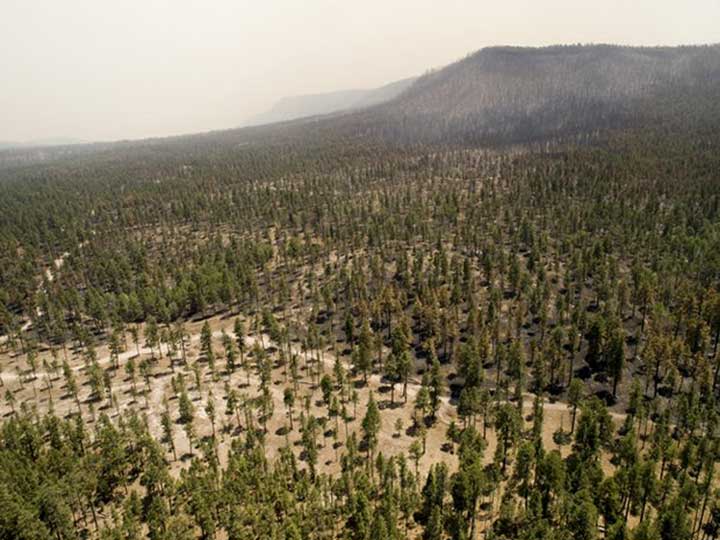
Two months ago in this space I wrote about the lost opportunity reflected in the flames consuming northern Arizona’s pine forests, where the Wallow Fire was making national news as it spread to become the largest ever in the state and burned almost 600,000 acres before it was contained.
The column mentioned the Arizona-based Four Forests Restoration Initiative, a Forest Service project that seeks to treat forest health concerns on 2.4 million acres over the next 20 years, in the process producing a mountain of low-quality logs and biomass. Too late to make the issue deadline, project leader Henry Provencio of the FS responded to an email and confirmed PW’s position—that the biggest obstacle to the project’s full implementation and success is the lack of local markets for the material to be utilized as small sawlogs, board furnish or biomass.
Provencio noted that “demand for our, primarily, small trees has not been what we hoped, so implementation has been slow and expensive. In response to the situation, we asked industry what was needed for them to move back to northern Arizona. The reply was a long-term commitment of supply, sufficient to meet the investment we are asking them to make. In order for us to meet that kind of commitment and just as important, to meet the restoration needs of our forests we had to go big.”
Now, recent research completed by the FS and published in Canadian Journal of Forest Research shows that aggressive thinning treatments are the most effective in reducing the probability of crown fires in the Western U.S., with fuel treatments that leave 50-100 trees/acre the most effective.
Though the optimal number of trees/acre varies by site, species, terrain and other factors, the study shows that “Once again, an ounce of prevention equals a pound of cure,” says FS Chief Tom Tidwell. “Thinning dense forests reduces the impacts of the catastrophic wildfires we’ve already seen this year and…helps protect communities, provides jobs and promotes overall better forest health.”
Tidwell noted that while 38 structures burned during the Arizona wildfires, thousands more were saved by fuel treatments implemented by federal, state and local agencies and private citizens that successfully reduced fire behavior. Computer simulations used in the study evaluating multiple treatment types and stand densities showed that the most intense treatments were more effective in reducing the threat of crown fires.
Of course, having the information and knowledge acquired from research and using it the right way are two different things. Here’s to hoping the FS can use the study results to aid in the implementation of its long-term forest health project in Arizona that has the potential to create new jobs while promoting forest health.