by Web Editor | Mar 2, 2015 | News
Composite panel consumption is projected to grow in North America through 2016, buoyed in part by the strengthening of the U.S. housing market and positive indicators of improvement in the furniture and related industries. Figures from Resource Information Systems, Inc. (RISI) project particleboard consumption to rise 10 percent in 2015, to 3.29 billion square feet, and grow 11 percent in 2016, to 3.64 billion square feet. Similarly, MDF is projected to hit 2.97 billion square feet in 2015, a rise of 9 percent, and jump to 3.28 billion square feet in 2016, up 10 percent.
Panel producers are gearing up, with already two companies announcing multi-million plant investments this year.
Uniboard announced Feb. 5 that it will invest more than $53 million at its Val-d’Or particleboard and thermally fused laminate (TFL) facility as part of its plan to increase productivity and upgrade key production areas. The company produces particleboard, MDF and TFL from mills in Val-d’Or, Sayabec, Mont-Laurier and Laval, Canada.
Uniboard President and CEO James N. Hogg said the project will enable the company to enhance its engineered wood and value-added product offerings. “Over recent years, Uniboard has invested heavily into product development, launching new color collections including North America’s first registered embossed thermofused laminate panels as well as expanding our successful NU Green range of low and no-formaldehyde products,” he added.
This followed the Jan. 26 news from Arauco that it will invest $30 million to grow the particleboard and TFL capacity at its mill in Bennettsville, SC. The new technology is expected to be in place by the fourth quarter. Arauco said increased dryer capacity will help it to improve its particleboard production by 60 million ft2, on a 3/4-inch basis annually. Arauco also will add a high-tech fast-cycle press for TFL production.
From Woodworking Network: https://www.woodworkingnetwork.com/wood/panel-supply/Composite-Panel-Market-Grows-Consumption-to-Hit-10-in-2015-294396371.html#sthash.7iZYxiAW.dpbs
by Web Editor | Feb 13, 2015 | News
From: Panel World Staff
The Vienna International Wood Products/Markets Conference, Expo & Tours will be held June 16-21 in Vienna, Austria. The event is organized by International Wood Markets Group, Inc. and Georgia Research Institute.
On June 16 will be an invitation-only Schweighofer Prize reception and dinner. The Schweighofer Prize ceremony is held every two years and awards money for technologies, products and services that strengthen the competitiveness of the European forest-based industries. More than 600 international delegates from 40 countries are expected to attend.
The conference and expo will be held June 17 at the Hotel Savoyen Vienna. Speakers from Europe and worldwide will address trends, issues and outlooks in international sawn wood and panel markets, including Europe, Russia, China, Middle East and North America. The full day conference will assess global market opportunities and wood products trade. Concurrently on June 17 an all-day wood products equipment supplier exposition will be held adjacent the conference.
June 18-19 will feature an Eastern Austria Industry Tour of mills producing lumber, cross laminated timber and engineered wood products. The tour starts and ends at the conference hotel in Vienna, with one night spent outside of Vienna.
On June 20-21, Schweighofer will host a tour in the Radauti area of Romania of its large single line sawmill, a laminated post-and-beam plant, an edge-glued panel plant, particleboard plant and pellet mill. The tour will spend two nights in Radauti and ends at the Vienna Airport.
Read more on this story in the March 2015 issue of Panel World…
by Web Editor | Feb 9, 2015 | News
Uniboard announced it will invest more than $53 million at its Val-d’Or particleboard and thermally fused laminate (TFL) facility as part of the panel producer’s plan to increase productivity and upgrade key production areas.
The company produces particleboard, MDF and TFL from mills in Val-d’Or, Sayabec, Mont-Laurier and Laval. Uniboard’s composite panel products are used in cabinetry, furniture, casegoods and flooring.
In making the February 5 announcement, Uniboard President and CEO James N. Hogg said the project will enable the company to enhance its engineered wood and value-added product offerings. “Over recent years, Uniboard has invested heavily into product development, launching new color collections including North America’s first registered embossed thermofused laminate panels as well as expanding our successful NU Green range of low and no-formaldehyde products,” he added.
The company received assistance from provincial and federal agencies including Investissement Québec and Economic Development Agency of Canada for the regions of Québec.
Founded in 1976, Uniboard employs more than 800 people, including 186 at the Val-d’Or facility. The company says it has an installed capacity of more than 640 million square feet of raw particleboard, high-density and medium-density fiberboard, of which more than 50 percent is converted into value-added thermally fused laminate and laminate flooring products. Uniboard was acquired by Kaycan in 2012.
From Woodworking Network: https://www.woodworkingnetwork.com/wood/panel-supply/Uniboard-Invests-53-Million-in-Particleboard-TFL-Plant-290986351.html#sthash.DrmfgcDP.d3FU2JWJ.dpbs
by Web Editor | Feb 2, 2015 | News
From: Panel World Staff
Arauco is investing $30 million to expand particleboard and TFL (thermally fused laminate/melamine) capacity for its Carolina Particleboard Mill in Bennettsville, SC.
The particleboard expansion, with a scheduled startup in the fourth quarter of this year, will increase production by 60MMSF (¾ in. basis or 100,000 m3) annually through increased dryer capacity. This project will also improve the plant’s flexibility to source a broader range of raw material in response to regional changes in the wood supply mix.
To complement the panel expansion, Arauco is also investing in a next generation fast-cycle press for TFL production, which is also scheduled to start in the fourth quarter. The new installation will add to the three existing fast-cycle TFL presses in the region.
The new line will further equip the particleboard and MDF site with a state-of-the-art press featuring higher throughput, faster changeover capabilities, higher pressure for deep textures and paper alignment technology for registered emboss designs. The company’s goal with these investments is to meet the growing demand for particleboard, and to broaden its TFL design offering in the region.
“These capacity and value-add investments translate into improved product sourcing options for our customers, and in turn generate additional long-term jobs for this manufacturing complex and the Bennettsville community at large,” states Mike Reardon, Regional Manufacturing Director.
by Site Manager | May 1, 2011 | Taking Stock
Story by Rich Donnell,
Editor-in-Chief
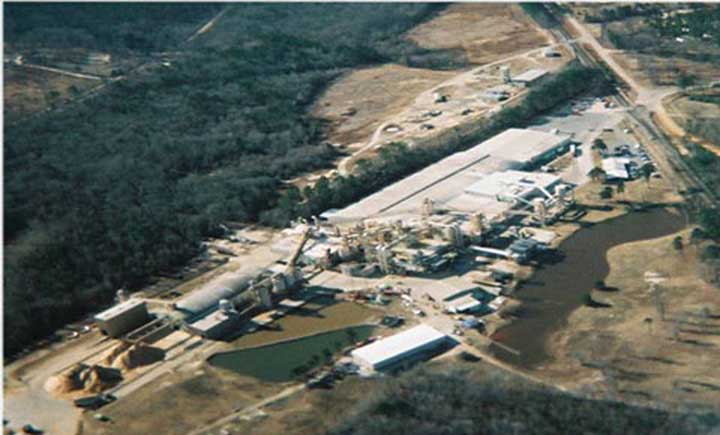
One of the more aggressive companies in recent years is Flakeboard, the Canada-based manufacturer of MDF, particleboard, melamine laminated products and other value-added items. We’ve been hearing a lot about Flakeboard’s investment in several melamine laminating lines, but we were wondering about its primary manufacturing plants, especially the ones it purchased from Weyerhaeuser back in 2006, and most specifically of these the MDF plant at Malvern, Ark.
Sometimes we visit plants and, as Forrest Gump said, “you never know what you’re going to get.” Especially a plant like Malvern, which has been around since 1968 and operated under four owners. Frankly, Malvern had fallen off our radar, until recently when we heard they had done some work there. During these recessed economic times, the word that a mill “has done some work” causes the editors at Panel World magazine to perk up. We asked for a visit and Flakeboard most graciously opened its Malvern doors.
While we enjoy visiting brand spanking new greenfield operations (see Uniboard-Moncure article, May 2010), we really get a charge out of touring an older plant that has undergone significant work. This is certainly the case at Malvern. For example, the old Washington Iron Works presses have undergone a total makeover, and the sanding line is now totally modernized. Operators weren’t shy about expressing their exuberance with the upgrade work and with the look of the “new” board product flowing through the plant.
At Malvern there is a spirit of re-birth, for two reasons really:
A) Flakeboard has committed some serious dollars to improving technologies throughout the plant.
B) Flakeboard is committing some serious time to improving the work force culture.
A and B don’t necessarily go hand in hand; that is, we’ve visited many a plant that did A and ignored B. From an editor’s perspective, these plants don’t make for a very enlightening visit.
You don’t necessarily have to do A while doing B, but it would seem that the implementation of B will become more effective if it’s tied into A.
However it’s done, we seem to be seeing more plants concentrating on their work force culture. There are lots of definitions of work force culture, and I’m sure there are consultants who know the exact definition, but the common thread appears to be greater participation and accountability for the work force. Pushing responsibility and decision making down the ladder if you will. Flakeboard at Malvern has gone so far as to strike the term “supervisor” from its glossary.
Of course employee empowerment is not a new concept. And we’ve seen many companies who began to change its work force culture, only to have an economic recession or an economic boom cast aside the noble notion.
Flakeboard is not one of these companies. For Flakeboard, employee involvement is part of its business philosophy. The plant manager at Malvern, Tom Quesenberry, told us that what makes the new cultural shift at Malvern so interesting is that he can look at other Flakeboard plants where the culture is embedded and clearly see where Malvern is headed.
It’s amazing what you can do at a 43-year-old composite board plant.