Roseburg Gets Chester Rolling

Roseburg Gets Chester Rolling

Roseburg Gets Chester Rolling

googletag.cmd.push(function() { googletag.display('div-gpt-ad-1548376180744-0'); });

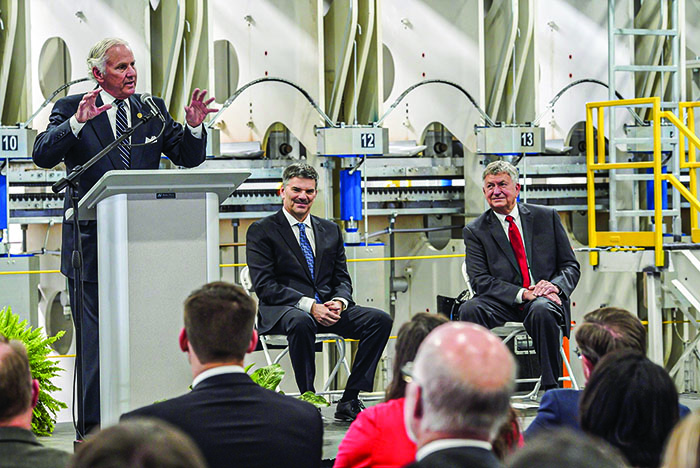
Roseburg Forest Products held a ribbon-cutting ceremony on October 28 to celebrate the grand opening of its newly constructed engineered wood products plant in Chester, SC. South Carolina Governor Henry McMaster participated in the event along with Roseburg President and CEO Grady Mulbery and Roseburg owner and Chairman Allyn Ford.

The Chester Engineered Wood plant features the highest-capacity LVL (laminated veneer lumber) press in the world. The project was first announced in summer 2017 and the construction team broke ground later that year. When fully operational, the plant will employ at least 145.

The Chester facility will produce LVL headers and beams used in residential and commercial construction. Roseburg first established its engineered wood business in 2001 and currently manufactures RFPI Joists, RigidLam LVL and RigidRim rimboard at its engineered wood products plant in Riddle, Ore.

Roseburg did extensive research prior to choosing a location for the new plant, with criteria including market demand, raw materials availability and cost, and business climate. Roseburg clients in the Eastern U.S. will now have access to a stable supply of high quality LVL products.

“South Carolina is a great state to do business in,” Roseburg President and CEO Grady Mulbery says. “Our research showed that this region was an ideal place to locate this facility, with its steady demand, healthy market and bountiful wood supply. Chester County and the state of South Carolina stood out, offering outstanding support and assistance as we navigated through the process.”

Attendees at the ceremony included state and local politicians, regional officials, and more than 100 recently hired plant employees. After the ribbon cutting, project leaders guided guests on a tour of the expansive manufacturing plant, which produced its first board on September 19.

“What started out as an undeveloped plot of land is now home to a state-of-the-art manufacturing facility thanks to the efforts of a team of people with the vision and knowledge to make it happen,” comments Allyn Ford, Roseburg owner and chairman. “Because of those efforts, 145 people will have jobs that did not exist before, and 145 families will earn a stable income in a safe work environment that contributes to the overall health and prosperity of this community and this state.”

Upon full production, the line will produce up to 285,000 m³ of LVL per year, made possible by microwave preheating and continuous press technology. Dieffenbacher supplied the LVL press and the upstream 600 kW microwave.

To produce high quality LVL, the veneers are evenly heated in the microwave over the entire mat thickness. The special design of the Dieffenbacher CPS press infeed means the distance the mat has to travel “without pressure” upon leaving the microwave until reaching the maximum pressing pressure is less than 2,500 mm. This prevents pre-curing of the resin. Fast-hardening glue can be used to increase production speed and capacity.

In addition to boosting capacity, the ideal combination of microwave and CPS also enhances board quality. The continuously produced LVL boards have more consistent mechanical board properties and significantly lower thickness tolerances. Subsequent sanding is not necessary. For example, unsanded LVL boards can be used directly as scaffolding planks, and unsanded veneers can easily be pressed into high quality boards.

Dieffenbacher LVL technology reportedly enables board thicknesses of up to 120 mm and allows MUF adhesives to be used in the top veneer overlapping area. The Roseburg line in Chester is Dieffenbacher’s eighth LVL project with a continuous press.

RELATED ARTICLES

PRODUCERS ANNOUNCE PERSONNEL CHANGES

ROSEBURG TO SHUT DOWN DILLARD P’BOARD

NEW STRATEGIC MARKETING MANAGER FOR ROSEBURG


googletag.cmd.push(function() { googletag.display('div-gpt-ad-1548375988914-0'); });

Latest News

Wisewoods Adds Second Dieffenbacher Z-Sifter In Thailand 

Wisewoods Co. Ltd. has commissioned a second Dieffenbacher Z-Sifter with Dryer Discharge Conveyor (DDC) for optimized material feeding at its medium-density fiberboard (MDF) site in Khao Yoi, Thailand, replacing two conventional sifters in an existing…

googletag.cmd.push(function() { googletag.display('div-gpt-ad-1589916740199-0'); });

Find Us On Social

googletag.cmd.push(function() { googletag.display('div-gpt-ad-1548376916922-0'); });
googletag.cmd.push(function() { googletag.display('div-gpt-ad-1548376961890-0'); });
googletag.cmd.push(function() { googletag.display('div-gpt-ad-1548377005333-0'); });
Newsletter

The monthly Panel World Industry Newsletter reaches over 3,000 who represent primary panel production operations.

Subscribe/Renew

Panel World is delivered six times per year to North American and international professionals, who represent primary panel production operations. Subscriptions are FREE to qualified individuals.

Advertise

Complete the online form so we can direct you to the appropriate Sales Representative. Contact us today!

New Strength And Safety Tests Pit Timber Against Concrete And Steel

Thanks to innovative construction materials like cross-laminated timber (CLT) and laminated veneer lumber (LVL), wooden buildings are no longer mere houses made of sticks.

Attracted by the aesthetic and environmental benefits of timber, structural engineers have overseen a lumber comeback, from Landlease’s International House development in Sydney’s Barangaroo district to Brisbane’s newly completed 25 King, which is the world’s tallest commercial timber building.

But with ambitious projects in Tokyo, Chicago, and London eyeing far greater heights for timber as a building material, engineers and the public need to be assured wood can match up with concrete and steel when it comes to safety and stability.

That’s why Griffith University’s Associate Professor Benoit Gilbert has been putting timber to the test, using high-tech machinery to better understand how timber behaves in a variety of situations.

Gilbert’s current tests focus on progressive collapse, a term that describes the severe failure of a structure due to something going wrong in one part of it. That could be a gas explosion, a fire or if a car were to collide with the building.

Read more on this from Create at https://www.createdigital.org.au/strength-safety-tests-timber/.

Structural EWP Exempt From New EPA Formaldehyde Regulations

The U.S. Environmental Protection Agency’s (EPA) new federal formaldehyde emissions regulations took effect on June 1st, 2018. As of this date all composite wood products must be certified as compliant with these regulations.The EPA defines composite wood products here as both domestic and imported particleboard, medium density fiberboard (MDF), and hardwood (decorative) plywood.

Structural engineered wood products made for construction applications are exempt from this regulation, including structural plywood, oriented strand board (OSB), wood I-joists, laminated veneer lumber, and glued-laminated timber. All of these products are manufactured with low-emitting, moisture-resistant adhesives in accordance with existing product standards and building codes, according to The Engineered Wood Association (APA).

For quick reference, structural engineered wood products marked with the APA Mark of Quality are considered exempt from the new regulations. If unmarked products from APA member mills are sold into applications that do not require a certification mark, the product invoice and an APA certificate of conformance can be used to identify the product as exempt.

The Formaldehyde Standards for Composite Wood Products Act was signed by President Barack Obama on July 7th, 2010, based on the Air Toxic Control Measure developed by the California Air Resources Board (CARB). The first phase of regulation rollout, now in effect, allows for compliance with either the CARB ATCM Phase II or the U.S. EPA TSCA Title VI. Starting March 22nd, 2019, only the U.S. EPA TSCA Title VI will be permitted as a path to compliance.

From Builder: https://www.builderonline.com/building/regulation-policy/structural-engineered-wood-products-exempt-from-new-epa-formaldehyde-regulations_o

Roseburg Names Odom Business Manager For Plywood And Lumber

Roseburg Forest Products has announced that Phil Odom has been named business manager for the company’s plywood and lumber business, a newly created role that consolidates the reporting structure of plywood and lumber sales organization. Reporting to Odom are the central planning manager, the plywood field sales team, and sales managers for lumber, softwood plywood, and hardwood plywood.

Odom has had experience at BlueLinx Corporation where he served as vice president of national business development, and at Georgia-Pacific. At both companies, Odom managed sales, distribution, manufacturing, and operations teams. Bringing a breadth of experience in organizational leadership and team development to the role, Odom has developed national sales strategies and built out new channels, markets, and product lines.

Odom holds a bachelor’s degree in business administration and marketing from Georgia Southern University. He has served as a board member of the Construction Suppliers Association and as an active member of both the North American Wholesale Lumber Association and the National Lumber and Building Material Dealers Association.

Founded in 1936, Roseburg Forest Products is a privately owned company and a producer of particleboard, medium density fiberboard, and thermally fused laminates. Roseburg also manufactures softwood and hardwood plywood, lumber, LVL, and I-joists. The company owns and sustainably manages more than 600,000 acres of timberland in Oregon, North Carolina, and Virginia, as well as an export wood chip terminal facility in Coos Bay, Oregon.

From Woodworking Network: https://www.woodworkingnetwork.com/roseburg-names-business-manager-plywood-and-lumber?ss=news,news,woodworking_industry_news,news,almanac_market_data,news,canadian_news

Metsa Wood Calls For Collaboration In Timber Innovation

Modular construction, using timber as a key element, is a credible solution to fast and sustainable house building. However, Metsä Wood believes that more needs to be done in terms of sharing knowledge and innovation in wood construction to further advance the use of this material in mainstream construction.

In order to help facilitate this process, Metsä Wood has launched its Open Source Wood initiative at www.opensourcewood.com. Metsä Wood’s Executive Vice President, Esa Kaikkonen, explains: “Not enough knowledge about modular wood design and building is shared, so wood construction remains niche. There is plenty of innovation but it is difficult to find, so Open Source Wood is our solution. We believe that with open collaboration the industry can achieve significant growth.”

The potential of wood is undeniable and today, offsite construction has major aspirations. Prefabricated wood elements enable fast, efficient and environmentally sound design without reducing quality. Reports on the benefits of such a lean approach are compelling: In a study of companies that have applied lean construction methods, 84% report higher quality in construction and 80% experienced greater customer satisfaction.

The report also highlights that almost 70% of projects that used prefabricated elements had shorter schedules and 65% had decreased budgets. Timber prefab construction also reduces other inconveniences such as the constant unloading of building materials, as well as the amount of on-site waste and the need to transport it.

Innovation in the house building sector is key, and offsite timber construction could be key in achieving the high volume of housing required. Using new and innovative products like Metsä Wood’s Kerto LVL (Laminated Veneer Lumber), homes constructed offsite can be turned around in a matter of weeks. Modern engineered wood products can be used for a variety of housing projects ranging from terraced and detached homes through to apartment blocks several stories high.

From Business Insider: https://markets.businessinsider.com/news/stocks/Metsa-Wood-Calls-for-Collaboration-in-Timber-Innovation-1012195818