
Auburn, U.S. Air Force Developing Mass Timber Military Housing Prototypes
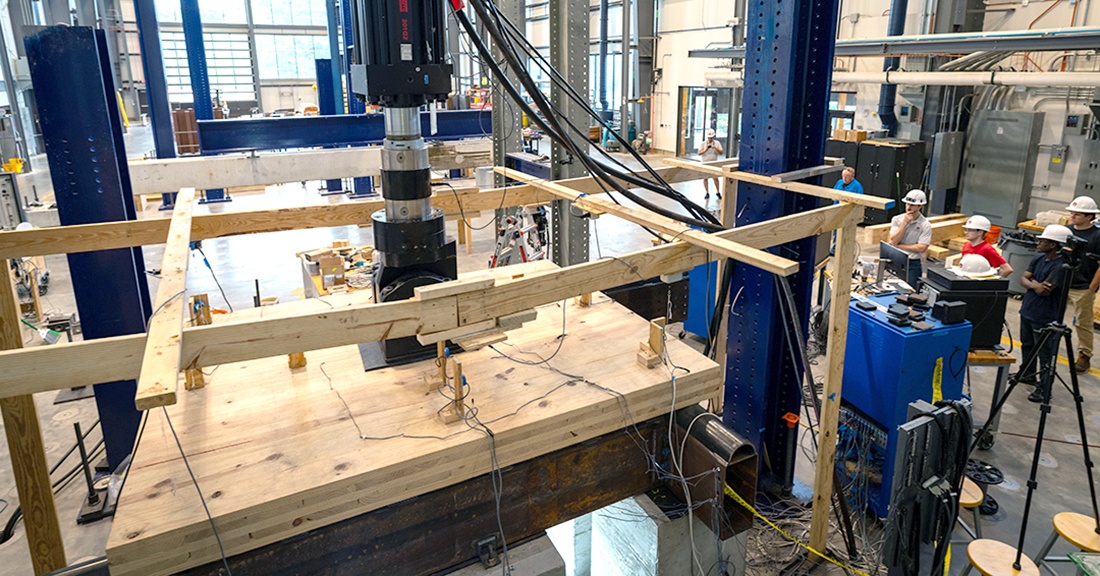 Auburn University engineers are working with the U.S. Air Force to redesign deployable military housing using mass timber, with the goal of creating temporary barracks-style structures that can be assembled faster and perform better in cold-weather environments.
Led by Auburn Engineering, the project combines structural design, materials testing and prototype development with architecture and building science expertise from Auburn’s College of Architecture, Design and Construction. Battelle is partnering with the Air Force to build prototypes.
David Roueche, the Gottlieb Associate Professor in the Department of Civil and Environmental Engineering says the Air Force needs temporary housing that can be transported, assembled and occupied quickly. Mass timber gives the team a way to meet that need by shifting more work into prefabrication, reducing on-site assembly time and improving thermal performance for cold-weather deployments.
Existing light wood-frame versions can require four or five people working eight- to 10-hour days over four or five days to build one structure—roughly 160 to 200 person-hours, Roueche says.
One of the central engineering challenges is finding the right balance between strength, efficiency and deployability. The structures must be durable enough for demanding environments without being overbuilt or difficult to transport.
That has required researchers to look beyond simply replacing conventional framing with mass timber. Standard cross-laminated timber (CLT) may be stronger and thicker than needed for this type of deployable structure, Roueche adds.
“Standard CLT is almost overkill for this application,” Roueche says. “It provides more strength than we need, so part of the challenge is figuring out how to use mass timber more efficiently.”
The team is evaluating designs intended to improve structural performance while also protecting insulation inside the assembly, an important consideration for cold-weather use. Testing in Auburn’s Advanced Structural Engineering Laboratory will help researchers verify the strength, stiffness and overall behavior of those designs.
According to Jake Elbrecht, assistant research professor in the McWhorter School of Building Science, a unique challenge in designing and constructing temporary housing is what happens at its end-of-life: “Air Force operations demand flexibility, and fixed housing impedes future redeployment. Designing temporary housing for disassembly and reuse accelerates redeployment and reduces long-term cost. Investigating structural performance, thermal performance and component reuse together reveals how these priorities compete and are weighed against one another in design decisions.”
Latest News
Is Dogwood Alliance For Climate Change?
A Future Forest + Jobs analysis of a Dogwood Alliance report finds that Dogwood’s policy recommendations would reduce carbon sequestration by 35%, shrink forest area, and eliminate more than 70,000 jobs in North Carolina. “These…
Dongwha Addresses Challenging Fiber
The Korean company Dongwha is securing the longest MDF press in Asia with an 8 ft. x 47.1 m press from Siempelkamp for processing the demanding raw material, acacia. In 2010 and 2015 VRG Dongwha,…
Plants Get Smart With Dryer Infeed
Sweed’s recently patented “Smart Pause” technology allows dryer infeed operators additional time to address misfeeds or other veneer feeding issues, while permitting the continued operation of the veneer dryer, thus maximizing dryer fill rates. Several…
Find Us On Social
Newsletter
The monthly Panel World Industry Newsletter reaches over 3,000 who represent primary panel production operations.
Subscribe/Renew
Panel World is delivered six times per year to North American and international professionals, who represent primary panel production operations. Subscriptions are FREE to qualified individuals.
Advertise
Complete the online form so we can direct you to the appropriate Sales Representative. Contact us today!