by Web Editor | May 22, 2015 | News
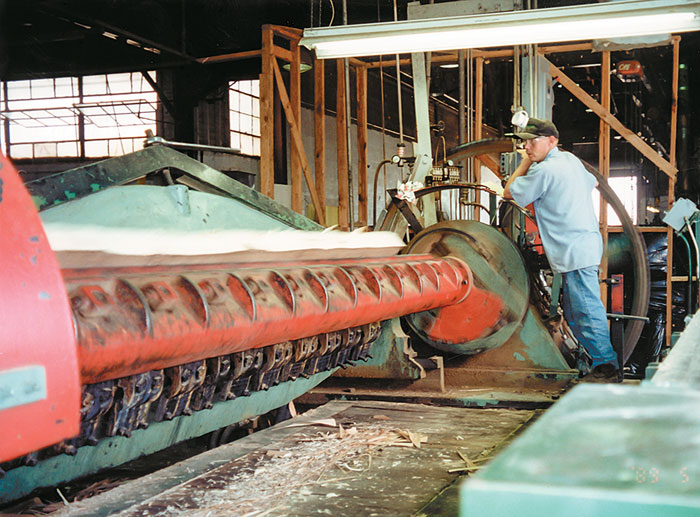
StemWood, a veneer and lumber mill, says it will wind down operations by the end of the 2015. StemWood produces high quality 4/4 walnut, cherry, white oak and red oak lumber as well as flitch and “clipped & bundled” hardwood veneers in a variety of species for a worldwide market.
“The exodus of American furniture manufacturing to Asia and the prolonged recession in new housing have been punishing blows to our business model,” says David Wunderlin, who has been president and part owner of StemWood since 1989.
Wunderlin said in a statement the closure is a management decision based on the economics of the company and the industry, and that its owners are actively seeking alternative operators or new uses for StemWood.
“StemWood is under no duress from any outside source,” Wunderlin says. “We are operating extremely well. Our productivity is high and our quality is excellent. Our management team simply understands how harshly the dynamics of our industry are working against us.”
Wunderlin says StemWood has seen over 90 customers or competitors cease production in recent years, including a dozen in its Southern Indiana locale. The owners say they are seeking alternative operators or new uses for StemWood.
From Woodworking Network: https://www.woodworkingnetwork.com/wood/wood-veneer/StemWood-Veneer-Lumber-Mill-Will-Close-Operations-Citing-Asia-Furniture-Closures-304042261.html#sthash.UEmMngWy.VwQH26V4.dpbs
by Web Editor | May 20, 2015 | News
PFS Corp. and Timberco, Inc. (TECO), two third-party certification agencies that have been linked for almost 25 years, have merged as of May 1, the company said in the press release received by Lesprom Network.
On May 1, 2015, Jim Husom, President and CEO of PFS Corporation, and Steve Winistorfer, President and CEO of TECO, signed papers merging the two companies. In announcing the merger, Jim Husom commented, “This merger combines what have been two well-respected and successful companies into one; and as one, we’ll be able to provide even more effective and efficient service to our existing clients and grow our business more than we could individually.”
The two companies together provide certification and testing services for more than a dozen different building products, including engineered wood products like LVL, I-joists, and glued laminated timber; plus SIPs (structural insulated panels), OSB (oriented strand board), softwood and hardwood plywood, metal plate connected wood trusses, adhesives, pre-cast concrete panels, hearth products, and construction fasteners for approximately 500 manufacturing plants.
Their testing laboratories, located in Wisconsin and Oregon, perform a variety of structural tests, durability tests, formaldehyde emissions tests, and some fire tests. The PFS Manufactured Structures Division provides design approval and factory inspections to over 120 HUD Code and modular building factories in 39 states and Canada.
From Lesprom Network: https://www.lesprom.com/en/news/PFS_Corporation_and_TECO_merge_67829/
by Web Editor | May 15, 2015 | News
North American OSB prices have fallen again in the first four months of this year.
The price for the benchmark grade OSB North Central 7/16”, researched weekly by the US information service Random Lengths, has almost consistently declined since December 2014. The price had at best stayed at the previous week’s level. No mark-ups occurred throughout this entire period.
The benchmark price had receded below US$200/1,000 sqft FOB for the first time in a while in January. It had reached US$180 at the end of March. This price had been left untouched for the following three weeks before softening again to US$175 in mid-April – the lowest level since July 2011.
This price was 19.7 % lower than the price of US$218 that applied at the end of April 2014.
From EUWID: https://www.euwid-wood-products.com/news/wood-based-panels/single/Artikel/north-american-osb-prices-continue-to-decrease.html
by Web Editor | Apr 29, 2015 | News
A new panel technology integrating wood, textile and geometric cutting patterns, is adding another dimension to furniture and architectural design.
Developed by Wood-Skin Srl, which was founded in 2013, the highly-flexible Wood-Skin panels incorporate a core of nylon mesh and polyester resin sandwiched between layers of Finnish birch plywood, MDF, OSB, Okume or other specialty materials, and finished with wood or stone veneer, laminates, metal or varnish.
After the panel core is made, 3D modelling software is used to create the design pattern. The sheets are then routed into the prescribed polygon shapes/angles. These become the bending points, or “digital hinges,” for shaping the one-piece Wood-Skin panel into architectural millwork, such as ceilings, curtain walls and facades, or as self-supporting 3D furniture, such as tables.
Already with projects under its belt Wood-Skin Srl also debuted its “Programmable Table” at this year’s Fuori Salone Del Mobile in Milan. The table was a collaboration with MIT’s Self-Assembly Lab, with Biesse as the technical sponsor.
Standard sheets of the Wood-Skin panel are 1200mm x 1250/2450/3050mm, 1500mm x 1550/2550/3050mm and 2500mm x 1250mm, with three thicknesses — 4mm, 6.5mm and 12mm — available. The company says Wood-Skin can be used for indoor or outdoor projects, and is available with water-resistant and fire-resistant characteristics.
From Woodworking Network: https://www.woodworkingnetwork.com/wood/panel-supply/One-Piece-Wood-Skin-Panels-Can-Be-Bent-Into-3D-Shapes-301211771.html#sthash.DPEom1yl.dpbs
by Web Editor | Apr 24, 2015 | News
Although it may seem counter-intuitive, it would be better if we built buildings from wood than from concrete, brick, aluminum and steel.
We use millions of tons of these modern materials every year. They have many valuable properties, but are energy-intensive to create, accounting for around 16% of the entire planets’ fossil fuel production. Instead we could be using wood, which is also strong, renewable, and plentiful – we use only a fraction of the world’s available forestry resources.
Our research, published in the Journal of Sustainable Forestry, estimated that the world’s forests contain about 385 billion cubic meters of wood, with an additional 17 billion cubic meters growing each year. A mere 3.4 billion cubic meters is harvested each year, mostly for subsistence fuel burning; the rest rots, burns in fires, or adds to forests’ density.
Swapping steel, concrete, or brick for wood and specially engineered wood equivalents would drastically reduce global carbon dioxide emissions, fossil fuel consumption and would represent a renewable resource. What’s more, managed properly this can be done without loss of biodiversity or carbon storage capacity.
In our study undertaken by scientists from the Yale School of Forestry & Environmental Studies and the University of Washington’s College of the Environment we evaluated various scenarios including leaving forests untouched, burning wood for energy and use of wood as a construction material.
From Architecture & Design: https://www.architectureanddesign.com.au/comment/swap-steel-concrete-and-brick-for-wood-wooden-buil?utm_source=WIT042415&utm_medium=Email&utm_campaign=WeekInTrees
by Web Editor | Apr 22, 2015 | News
Total exports of U.S. hardwood lumber and veneer to the Middle East and North Africa (MENA) region reached a record USD 108.93 million for the year 2014, according to the American Hardwood Export Council (AHEC), the leading international trade association for the American hardwood industry. The statistics, which have been compiled from the latest data released by the United States Department of Agriculture (USDA), reveal an overall 20 percent increase over 2013 figures. The announcement was made on the sidelines of the Dubai WoodShow 2015 where AHEC is hosting the largest ever American Hardwood Pavilion, featuring twenty-one U.S. hardwood lumber and veneer exporters.
According to the data released, exports of American hardwood lumber reached a value of USD 79.07 million and a volume of 98,425 cubic meters during 2014. This equates to an increase in value of 23 percent over 2013 and an increase in volume of 8 percent. Direct exports of U.S. hardwood veneers to the MENA region reached a total value of USD 29.86 million last year, rising by 12 percent from 2013. However, it is important to note that American hardwood veneers are also shipped to the region from European countries and China, while veneers are also produced in the region – notably in Turkey – from imported American hardwood logs. U.S. hardwood log exports to the MENA region reached a total volume of 34,957 cubic meters and a value of USD 20.47 million in 2014.
Commenting on the record exports to the region, Roderick Wiles, AHEC Director for Africa, Middle East, South Asia and Oceania, said: “The most significant increases in shipments of U.S. hardwood lumber were seen in the United Arab Emirates (up by 48 percent to 15,723 cubic meters), Egypt (up by 22 percent to 11,614 cubic meters), Jordan (up by 18 percent to 5,949 cubic meters), Lebanon (up by 23 percent to 4,735 cubic meters), Qatar (up by 55 percent to 3,015 cubic meters) and Morocco (up by 31 per cent to 2,329 cubic meters). However, a marginal downturn in volume of only 2 percent was seen in shipments to Turkey, which reached 12,700 cubic meters and a slight downturn was seen in shipments to Saudi Arabia, which reached 10,513 cubic meters.”
From Zawya: https://www.zawya.com/story/Exports_of_US_hardwood_lumber_to_MENA_reaches_record_USD10893m_in_2014-ZAWYA20150415105310/