by Web Editor | Jan 18, 2017 | News
Mass timber is sprouting up in cities in North America and abroad. After years of feasibility studies and design proposals, buildings six stories or taller constructed primarily from pre-engineered wood products are being considered in cities around the world.
In London, one proposal, called the Splinter, would rise to 100 stories. In Chicago, Perkins+Will (in collaboration with Thornton Tomasetti and the University of Cambridge) has designed an 80-story high-rise with 300 duplex apartments. If built, River Beech—a key component of P+W’s master plan for the Riverline development—would be made almost entirely from mass timber.
So-called “plyscrapers” are still a tiny sliver of nonresidential construction. In the past five years, only 17 buildings seven stories or taller have been completed worldwide, mostly in Europe and Canada. Six more have started construction, according to the American Wood Council.
Mass production of timber for high-rise construction is still in its infancy in North America. Specifying these products in the U.S. faces resistance from insurers, regulators, and code officials. Steel fabricators and concrete suppliers disparage mass timber for taller buildings on the grounds of safety and durability.
Proponents cite the speed at which tall buildings can be constructed using pre-engineered wood and mass timber’s ability to sequester carbon. Joey-Michelle Hutchison, RA, LEED AP BD+C, CSBA, Associate Vice Principal, CallisonRTKL, says, “The role of mass wood is going to grow because of the demand for sustainable design.” Researchers from Yale and the University of Washington, in a study published in the Journal of Sustainable Forestry (March 28, 2014), postulated that using wood substitutes for constructing buildings (and bridges) could save 14–31% of global CO2 emissions.
From Building Design + Construction: https://www.bdcnetwork.com/mass-timber-what-heck-wow
by Web Editor | Jan 11, 2017 | News
North American Plywood has launched DesignPly, a new panel offering based on a first of its kind digital staining technology. The highly-automated production incorporates a high-speed wide-array inkjet press engine paired with robotic materials handling for on-load and off-load of materials in process.
Printing direct to substrate, North American Plywood has adapted an Inca Onset high-definition inkjet press into its panel processing system, employing a carefully calibrated digital staining and finishing process.
Employing instantaneous UV curing, the DesignPly system can replicate a variety of wood grain and other patterns to achieve the effect of top-grain veneer species in bookmatch or other patterns, on particleboard, MDF, metal and melamine panel. The DesignPly system can convert plywood into the look of veneer, beaded board, or laminated lumber surfaces, accepting panel sizes up to 63” x 123” and thicknesses up to 2”.
Developed and built in the U.K. and sold by Fuji, the Inca Onset multi-array inkjet press uses three sets of high speed heads to print on surfaces at the rate of 10,000 square feet per hour – roughly 200 5×10-foot sheets per hour. Originally adopted for point-of-purchase prints and store displays, the Inca Onset is being adapted to plywood panel for the first time by North American Plywood.
From Woodworking Network: https://www.woodworkingnetwork.com/news/woodworking-industry-news/high-def-digital-staining-plywood-simulates-fine-bookmatch-anigre?ss=news,news,woodworking_industry_news,news,almanac_market_data,news
by Web Editor | Jan 9, 2017 | News
To be competitive in the wood products industry, companies must stay on the cutting edge. But to get to the forefront, wood products companies must invest in their production facilities to increase automation and efficiency, and to lower manufacturing costs, experts say.
“It’s a competitive market,” said Jon Anderson, president and publisher of Random Lengths, a wood products industry trade publication based in Eugene. “Unless people are investing in their plants, they’re going to fall behind and, ultimately, fall by the wayside probably in the tougher markets.”
In the past couple of years, Swanson Group in Springfield, Seneca Sawmill in Eugene, Weyerhaeuser in Eugene, and International Paper in Springfield have made major investments in their facilities totaling about $273 million. Such upgrades are part of a trend throughout the North American woods products industry, Anderson said. Wood products companies in the Pacific Northwest, Canada and the southern United States have improved their operations, he said.
The improvements can help firms capture market share during strong markets and allow them to stay afloat when the economy weakens. “It’s the more efficient, more productive producer that is going to survive the downturns,” Anderson said. “We’re not in a downturn now, but most of these operators have gone through ups and downs in their time, and they are going to get ready for the next one.”
Seneca Sawmill on Highway 99 in Eugene is nearing the end of a major facilities renovation, including the installation of new kilns, revamping its shipping and loading facility and expanding its log yard. Early this year, the company plans to upgrade its planer, the equipment that smooths lumber. By the time it’s finished, the firm will have spent $63 million on improving its operations.
From The Register-Guard: https://registerguard.com/rg/business/bluechip/35084194-62/competition-drives-mill-investments.html.csp
by Web Editor | Jan 6, 2017 | News
The United States International Trade Commission says there is a “reasonable indication that a U.S. industry is materially injured by reason of imports of hardwood plywood from China that are allegedly subsidized and sold in the United States at less than fair value.”
Noting all six of its commissioners voted in favor, the U.S. Department of Commerce will continue to conduct its antidumping and countervailing duty investigations on imports of hardwood plywood. A judgment on whether countervailing duties should be levied to discourage the imports is due February 13, 2017, and its preliminary antidumping duty determination due on or about April 27, 2017.
The issue is contentious, with U.S. plywood makers – the Hardwood Plywood Coalition – battling to restrict China’s exports, while an opposing group that buys plywood for casegoods, the American Alliance for Hardwood Plywood (its members include the Kitchen Cabinet Makers Association) wants to allow imports to continue as is.
Indeed, the American Alliance for Hardwood Plywood issued a statement expressing disappointment in the ruling by the International Trade Commission. AAHP Chairman Greg Simon issued the following statement:
“We are disappointed that this investigation will proceed, but remain very confident that the facts continue to be on our side. This is now the third time that the federal government will conduct a thorough review and we believe they will reach the same finding as before–imported hardwood plywood products from China are traded fairly at competitive prices and have a rightful place in the global consumer market. This continued legal harassment by CFTHP against imports is putting thousands of U.S. jobs at risk during a time when manufacturing is in desperate need of revival. Our alliance of small medium and large American importers, distributors, retailers of hardwood plywood and domestic kitchen cabinet manufacturers remains united in opposition to these bogus charges and look forward to presenting our side to the ITC and Department of Commerce in the coming months.”
From Woodworking Network: https://www.woodworkingnetwork.com/news/woodworking-industry-news/china-hardwood-plywood-dumping-gets-third-review-international-trade?ss=news,news,woodworking_industry_news,news,almanac_market_data,news
by Web Editor | Jan 4, 2017 | News
When the 12-story Framework building planned at Portland’s Northwest 10th Avenue and Glisan Street is complete, it may look to passers-by like any other Pearl District condo tower.
But it will hold a special distinction in the sustainable building world: the nation’s tallest building made primarily from mass timber (long pieces of timber, glue-laminated together).
Designers and engineers across the country are chasing an innovative style of mass timber construction pioneered in Europe, which they believe will go a long way to reduce the carbon footprint of large buildings.
The breakthrough came with the development of cross-laminated timber or CLT: Large, layered flat panels used as floors and walls (rather than just beams as vertical posts).
As Oregon moves on multiple fronts to take the national lead in all-wood construction for tall buildings, Portland State University stepped up early to do basic research. PSU won a three-year, $400,000 National Science Foundation grant to study two aspects of mass timber construction: its sustainability and how well it resists earthquakes.
From Sustainable Life: https://pamplinmedia.com/sl/337694-214716-psu-tests-new-green-woods-seismic-strength
by Web Editor | Dec 28, 2016 | News, Update
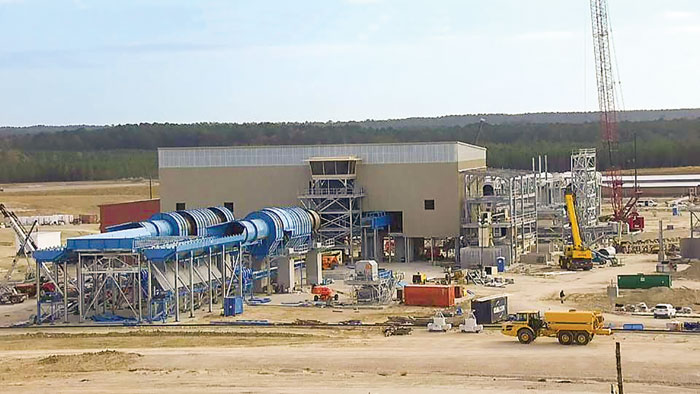
New OSB Mill Still On Schedule
googletag.cmd.push(function() { googletag.display('div-gpt-ad-1548376180744-0'); });
Work continues in Corrigan, Texas on a new oriented strandboard (OSB) manufacturing plant, the first such facility in the Lone Star State for RoyOMartin. Due to open in fall 2017, the plant represents a $280 million investment, is situated on 158 acres, and adds 165 direct jobs.
Corrigan OSB, L.L.C. is the only greenfield OSB plant under construction in the country and, upon its completion, will ship its products throughout the U.S.
In September, company officials and the East Texas community celebrated the grand opening of the plant’s administration building, which marked the beginning of the transition from a construction site to a fully operational facility. Construction began in July 2015 and is nearly halfway complete. About 30 employees have been hired to date.
“We believe East Texans share our passion for excellence and experience,” says Roy O. Martin III, president, CEO and CFO of RoyOMartin. “We have sold into the Texas market for a long time, and now we look forward to becoming a proactive partner in the community.”
RELATED ARTICLES
MARTCO ANNOUNCES CORRIGAN “TWO”
ROYOMARTIN ADDS PRODUCTION LINE IN CORRIGAN
HAPPY 25TH BIRTHDAY CHOPIN PLYWOOD
TIME IS FREE BUT IT’S PRICELESS
ROY MARTIN III PAINTS REFRESHING, POSITIVE PICTURE
googletag.cmd.push(function() { googletag.display('div-gpt-ad-1548375988914-0'); });
googletag.cmd.push(function() { googletag.display('div-gpt-ad-1589916740199-0'); });
googletag.cmd.push(function() { googletag.display('div-gpt-ad-1548376916922-0'); });
googletag.cmd.push(function() { googletag.display('div-gpt-ad-1548376961890-0'); });
googletag.cmd.push(function() { googletag.display('div-gpt-ad-1548377005333-0'); });
The monthly Panel World Industry Newsletter reaches over 3,000 who represent primary panel production operations.
Panel World is delivered six times per year to North American and international professionals, who represent primary panel production operations. Subscriptions are FREE to qualified individuals.
Complete the online form so we can direct you to the appropriate Sales Representative. Contact us today!